
Electronic Projects, forums and more.

Go Back   Electronic Circuits Projects Diagrams Free > Electronic Content > Electronic Projects


Electronic Projects A collection of small electronic circuits and projects you can build.

Reply
 
Tools
Old 25th July 2002, 02:13 AM   #1
Default DC Motor Control Circuit

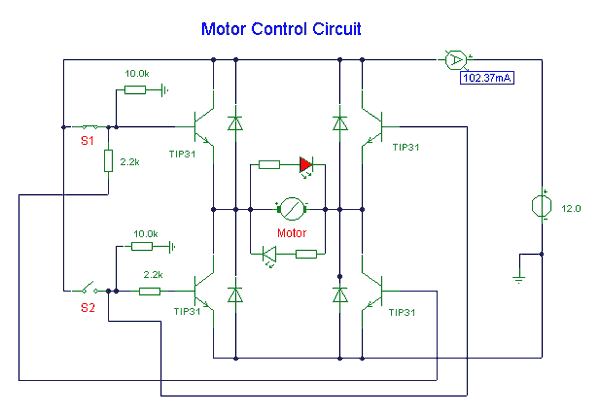
Here, S1 and S2 are normally open , push to close, press button switches. The diodes can be red or green and are there only to indicate direction. You may need to alter the TIP31 transistors depending on the motor being used. Remember, running under load draws more current. This circuit was built to operate a small motor used for opening and closing a pair of curtains. As an advantage over automatic closing and opening systems, you have control of how much, or how little light to let into a room. The four diodes surriunding the motor, are back EMF diodes. They are chosen to suit the motor. For a 12V motor drawing 1amp under load, I use 1N4001 diodes.
__________________
Electro Tech Online Owner
Need to contact me? Send me a Private Message.
Verification Email didn't arrive? See this thread.
ElectroMaster is offline  
Old 26th January 2005, 06:34 PM   #2
Default if wish to control motor speed using pwm?

i wish to control motor speed by trigger the BJT/mosfet(i m using mosfet in my project). The output voltage(between motor) i get wont come out as my expected(not a rectangular waveform) and got a lot of distortion. Average value of my Vout is higher much than expected, let say pwm duty cycle is 10%, average voltage i get is 40-50%. Why this problem occur? Can give me a solution or suggestion?
iclok is offline  
Old 20th February 2005, 11:51 AM   #3
Default

Try searching for info on 'H Bridges' and pwm strategies...a good site i've used before is http://www.4qd.co.uk

Cheers

----------------------------------------
Steve www.circuithut.com - electronic projects site
SteveM is offline  
Old 26th December 2005, 09:24 PM   #4
Default

sorry if i m mistaken but i u r using a mechanical 'push' button... then wats the need of those free wheeling diodes,resistors, etc?
__________________
absence of evidence is not evidence of absence
addyismad is offline  
Old 28th December 2005, 04:01 AM   #5
Default

You should use a single SPDT switch in place of S1 and S2. This will prevent the circuit from burning out if both S1 and S2 are closed simultaneously.
__________________
"There is no way to peace, peace is the way!"
kinjalgp is online now  
Old 4th February 2006, 10:54 AM   #6
Default

Couple of problems with this design

1) the LED's around the motor.
Since they are in anti-parallel it will ensure an LED will light up depending on th evoltage flow

BUT in doing so you have provided a clamp across the motor, a clamp of 1.2V as a rule of thumb with LED's

The speed of a brushed-DC is proportional to the voltage at the terminals


2) inadquate gate-drive
__________________
Nothing is impossible.
Once a problem is realised, the rest is just details


Styx is offline  
Old 4th February 2006, 11:38 AM   #7
Default

Quote:
Originally Posted by Styx
BUT in doing so you have provided a clamp across the motor, a clamp of 1.2V as a rule of thumb with LED's
The speed of a brushed-DC is proportional to the voltage at the terminals
No problem . there is a resistor in b/w the led and motor .
akg is offline  
Old 4th February 2006, 12:08 PM   #8
Default

Quote:
Originally Posted by akg
Quote:
Originally Posted by Styx
BUT in doing so you have provided a clamp across the motor, a clamp of 1.2V as a rule of thumb with LED's
The speed of a brushed-DC is proportional to the voltage at the terminals
No problem . there is a resistor in b/w the led and motor .
Very true, but then you set that burn-resistor to drop a certain potontial;

Say you set it for the DC-link at 12V so the burn-resistor drops 10.8V. THAT is only good IF you go into over-modulation or 100% PWM

Less and the brightness drops


Say you set it for a lower voltage, IF you over-drive it then you will burn it out.

BEst bet would be to have the LED hanging off the gate signal instead
__________________
Nothing is impossible.
Once a problem is realised, the rest is just details


Styx is offline  
Old 4th February 2006, 12:10 PM   #9
Default

Quote:
Originally Posted by Styx
Very true, but then you set that burn-resistor to drop a certain potontial;
Say you set it for the DC-link at 12V so the burn-resistor drops 10.8V. THAT is only good IF you go into over-modulation or 100% PWM
Less and the brightness drops
Say you set it for a lower voltage, IF you over-drive it then you will burn it out.
BEst bet would be to have the LED hanging off the gate signal instead
Ok..I agree..
akg is offline  
Old 4th February 2006, 01:00 PM   #10
Default

errr saturday morning, brain kicking in, IF the LED's were hung of the gate-signal they would be provided with a PWM and thus they would dim with lower PWM.

so looks like no matter where you put the LED's they will dim with low duty, unless you made a FWD/REV signal
__________________
Nothing is impossible.
Once a problem is realised, the rest is just details


Styx is offline  
Old 9th March 2006, 05:22 PM   #11
Default

how if i want the signal only 5v and control the 12 v motor?
bananasiong is offline  
Old 6th April 2006, 10:11 PM   #12
Default

Another problem with this circuit is the top two transistors are configured as emitter followers so they never fully saturate and you don't get any voltage amplification either. If you shift the components about a bit you can swap them for PNP transistors like TIP32s which will sove this problem.

Another thing, what happens if the user presses both S1 and S2?

There needs to be some sort of interlock to prevent this - a few logic gates might do.
__________________

I do not answer private messages asking for help because no one else can: benefit from advice I may give or correct me if I'm wrong.

Please ask on the open forum if you have a question and I'll be happy to help,
if I know the answer.
Hero999 is offline  
Old 7th April 2006, 01:38 PM   #13
Default

Very good DC Motor Control solution.
Attached Files
File Type: pdf dc_motor_control.pdf (126.9 KB, 1347 views)
elcopart is offline  
Old 27th December 2006, 06:33 AM   #14
Default

if i may add to this post i would like to say that my learning expereince is that im still learning ..so dont think im a know it all it's just i noticed how you all where discussing the l.e.d. subject on the schematic at the begginig...
if you remove the led's and add a duel singal throw switch and add the l.e.d's and the requiered voltage to one side of the switch as to indicate dirrection then the problem with clamping would be overcome don't you think?
magoo is offline  
Old 9th January 2007, 09:35 AM   #15
Default

anyone could help me to design thyristor gate controller?
(alpha angle control @ firing angle control)
black2sic is offline  
Reply

Thread Tools
Display Modes


Similar
Title Starter Forum Replies Latest
Looking for AC motor speed control circuit Tako Kichi Electronic Projects Design/Ideas/Reviews 5 17th January 2009 12:34 PM
Motor control circuit crunch53 Electronic Projects Design/Ideas/Reviews 3 12th November 2005 05:02 PM
Need a timing circuit for motor control crunch53 Electronic Projects Design/Ideas/Reviews 2 16th October 2005 02:39 PM
control circuit to motor circuit does it matter what wire i? troyandash Robotics Chat 2 21st May 2004 12:26 PM
4 stepper motor control circuit- help!!! ajay_kumar_d Electronic Projects Design/Ideas/Reviews 3 19th March 2004 12:54 PM


All times are GMT. The time now is 04:41 AM.


Electronic Circuits  |  Learning Electronics
eXTReMe Tracker