![]() | ![]() | ![]() |
| |||||||
| Electronic Projects Design/Ideas/Reviews Are you building an electronic project or want to? Maybe you need some assistance? Come and submit your electronic questions here and let our experienced members find a solution. |
![]() |
| | Tools |
| | #1 |
|
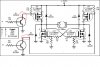
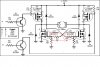
I think i posted this yesterday. seems that this post went missing OK looking at the diagram below, the Vgs of the MOSGETS are being supplied with 12V from the power supply. After reading through some mosfet material, it seems that the mosfet Id and Rds is controlled solely by the Vgs. I circled the 2 resistors at the N-channel gate. Are they necessary? since the gate is controlled solely by voltage Thx in advance for any comments | |
| |
| | #2 |
|
Purpose of gate resistors in MOSFET circuits are to control the switch-on and off times, and also to help prevent parasitic oscillations
| |
| |
| | #3 |
|
Heh. i thought they were current limiting resistors at first. I thought that switch on and off time were already controlled by the 10K resistors across the gate-source junction. Do the P-channel mosfets require them then? By the way, what do you mean by parasitic oscillation? does it mean noise? | |
| |
| | #4 |
|
The resistors between the gate and source is to prevent the device from turning on when the gate (high impedance) is not connected to a drive signal (it is a safety precaution and good practice). For high frequency operation these will often be omitted due to the unwanted effects from stray properties Myself as a rule always put some gate resistor in series, sometimes only a small value (22 -100Ohm) depending on my design (device) and switching frequency. In your case the values are high because you are operating at DC. If you make the value too high the max gate voltage will be limited by voltage divider action. The same will happen if you make the g-s resistor too low. Parasitic oscillations, can cause the device to go into high frequency oscillations under certain conditions that can destroy the device due to heat. http://www.fairchildsemi.com/an/AB/AB-9.pdf Note that selecting gate resistors, the values are calculated for critical switching applications by using data and not by "rule of thumb" | |
| |
| | #5 |
|
One thing i dont understand is how can gate resistors control the on-off time. werent the rise-time and fall-time already determined by the type of transistor used?. I dont recall there were any equations relating resistance to switching frequency. :?: :?: | |
| |
| | #6 | |
| Quote:
For a BJT to start to conduct it MUST have abt 0.6V at its base-emitter. For a FET something similar is needed. There exists a Gate-Source capacitance. Sicne as you now there is a gate threshold voltage that needs to be reached before the device starts to conduct. So if you put a series GATE resistor you now have effectively a low-pass filter So If you increase the gate resistance then it will take longer for the gate capacitance to charge up. If it takes longer for the gate capacitiance to become charged then it will take longer for the FET to start conducting. You really want the FET's to turn on as fast as possible so use a 10Ohm resistor. A trick that I use When dealing with H-bridges made from IGBT's and FETS is to use for the gate resistor for each FET a resistor and a resistor-diode in parallel. That way (depending on the orientation of the diode) I can have a slow turn on and a fast turn-off. That way I can stop shoot-through during switching of a H-bridge leg | ||
| |
| | #7 |
|
The gate has input capacitance, so a certain current is necessary to charge it up in some time period. If you make the series resistor low it will charge and discharge faster. Some applications you want very fast switching and others you choose to burn up some energy in the device to reduce voltage spikes caused by leakage inductances at turn off. The faster you turn of the device in this case can produce voltage spikes high enough to exceed the Vds max of the device due to the relation V=L(leakage)*di/dt where di = change in current, dt = time to turn off So for example with 1uH of leakage inductance and 10A current change, switching off in 100nS will cause a voltage spike of 100v over your device, which over the Vds rating for your device. So it is a balance of the amount of energy you will allow the device to burn and the inductive spike your device can handle. With inductive loads the problem is not normally at turn on, as current will ramp up (voltage leads current) due to the inductance reducing the instantaneous power dissipation in the device As Styx said you can have different on and off times by using another resistor and a diode in the gate circuit. | |
| |
| | #8 |
|
So not what I said then One??? As to the overshoot, true the overshoot is directly related to the switching speed of the FET. BUT it is more related to the matching of the free-wheel diode as well as power-component layout. To minimise the overshoot. First ensure that the anti-parallel diode is match (in its switching characteristics) to teh MOSFET. Equally, the stray inductance between the FET's Source and the Diodes kathode (as well as the FET's Drain and the Diodes Anode) Needs to be reduces via the use of decent tracking (preferably via BUS-BARS). Also DC-link capacitance of suitable value and material also helps Then and only then look at the voltage overshoot w.r.t. the switching speed of the FETS. In principle the switching speed of the FET needs to be as fast a posible to reduce the switching losses. You will always get an overshoot. However, the overshoot level w.r.t. the voltage rating of the device as well as the switching speed needs to be examined. If the device is rated as say 1200V and at full current you get an overshoot of 600V I wouldn't be concerned. But 800V and I would then start slowing down the particular device that is havin gthe problem (if no improvement in the power layout can be achived) | |
| |
| | #9 | |
| Quote:
we are here to help each other. "TheOne"
| ||
| |
| | #10 |
|
hehehehe. thanks alot for helping me out. Really envy you guys for having so much knowledge. :cry: I just want to confirm this. Since the gate resistors play such a crucial role in mosfets, i should also add a resistor at the red circles right? | |
| |
| | #11 |
|
yup, although the on-state resistance of the BJT that is pullting charge out of the to FET mght be high enough - put one in just in case (low value - 10R). You might have a problem with your two top FET's. They are being turn off by the 10k resistors and that might be extreamly SLOW. With H-bridges Turn-off MUST be fast adn Turn-on slower You should always have a resistor at the gate of a FET. Since a capacitor is essentailly a short for AC, when you first pulse a FET's Gate there is nothing to limit the gate current and if you are very unlucky you could burn out the gate Also if you are also unluck you could set up a pearce oscillator. always some gate resistance And also dont be envious of us with our knowledge, believe me it is a curse | |
| |
| | #12 |
| DO and DON'Ts for MOSFETS Definitely a "must read" for rookie engineers http://www.irf.com/technical-info/appnotes/an-936.pdf | |
| |
| | #13 |
|
?? has anyone else noticed that the two lower Fets gates are connected to the motor drive circuitry?? who knows what all that static will do to the overall operation of the circuit?? | |
| |
| | #14 |
|
I know!!! What I dont understand is why he isnt shorting the P-type and the N-type gates together of one H-bridge leg. Then use a NPN-PNP push-pull gate driver per leg | |
| |
| | #15 |
|
i have seen this circuit somewhere before.. wasnt it designed for BJTs?? | |
| |
|
| Tags |
| bridge, gate, mosfet |
| Thread Tools | |
| Display Modes | |
| |