![]() |
![]() |
![]() |
|
|
|||||||
| General Electronics Chat This forum is for general chat about electronics, eg: Dont know what a part does? Dont know how to read a circuit? Want to get an opinion? |
|
|
Thread Tools | Display Modes |
|
|
(permalink) |
|
New Member
|
sry if this is in the wrong forum, i dont know much about electronics
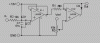
I got this schematic off a site that was last updated about 6 years ago, so i couldnt e-mail the author the question. its for my car, my computer on my car cuts the fuel if boost from the turbo goes beyond 11psi, the MAP sensor tells the computer how much boost the engine is taking in. So if you let the MAP sensor send its normal signal until the voltage for 11psi(around 4.7v) is reached and then make it stay at that voltage the computer wont know you are getting higher boost than 11psi(or whatever you set the clamp to). So this device i posted allows current to pass through normally until the voltage set by R3 is reached and then clamps the voltage at that point. This voltage clamp is designed to limit the input voltage based on the voltage set by the trimmer at R3 (Vref is 5v input), and then send it to output. But it doesnt limit the input voltage until the set voltage is reached. Sorry if thats hard to understand cause i suck at explaining things. But my question is, i dont have a 12v on my application so i really dont need it on the voltage clamp. And i figured since it has a diode that blocks the 12v to the system anyway i could just take it off completely without affecting the performance of the device. So do you guys think it would affect anything? And also it says "Noise suppression is achieved via the use of a low pass filter on the input, formed by R2 and C1. High frequency roll-off is at about 100 Hz, allowing the circuit to be responsive but effectively suppressing RF noise.", so does the D2 diode have to stay in the schematics for this to work still? Or can it be taken out since the 12v line and diode was taken out? Here is what i would like to have it set up as think it will affect it any? |
|
|
|
|
|
(permalink) |
|
Experienced Member
|
"32", that 12 volt line has to stay there. The diodes are series-connected between +12v and ground so that the voltage on pin 3 of the IC will not be damaged by spikes on the input that exceed the supply voltages on the chip. Your original schematic does not show the ground (pin 4) and Vcc or +12v connections (pin 8) to the IC. So you still need the +12v even if you were to eliminate the voltage clamp at the input. The IC has to have the +12v and ground connections just like your TV set needs to be plugged in to get a TV signal to the tube.
So, leave the original schematic as is and don't forget to add power and ground to the chip connections which are not shown on your skem. Dean
__________________
Dean Huster, Electronics Curmudgeon Contributing Editor emeritus, "Q & A", of the former "Poptronics" magazine (formerly "Popular Electronics" and "Electronics Now" magazines). R.I.P. |
|
|
|
|
|
(permalink) |
|
New Member
|
so something like this???
also, im really new to electronics but when reading a schematic and two lines intersect, how do you know if they are supposed to be connected or not??? like between D1 and D2, do those intersecting wires connect to each other? When i added the line from pin 8 to 12v from the IC on the right i put a gap in the line when intersecting the output line to show that it doesnt connect, but thats probably not how you are supposed to do it, so how would you draw that? |
|
|
|
|
|
(permalink) |
|
Experienced Member
|
LM358 is a dual op-amp, so the supply pin 4 and 8.
|
|
|
|
|
|
(permalink) |
|
Experienced Member
|
I think Sebi was trying to say that since the op amp is a dual op amp, you only need to show the power connections on one of the halves, not both. And traditionally, we put power at the top of the triangle, groung (or negative) at the bottom and leave that left side for the input pins.
(pin 8), that is "pin 8" enclosed in parentheses in my first post came out as a happy face. Really weird. Dean
__________________
Dean Huster, Electronics Curmudgeon Contributing Editor emeritus, "Q & A", of the former "Poptronics" magazine (formerly "Popular Electronics" and "Electronics Now" magazines). R.I.P. |
|
|
|
|
|
(permalink) |
|
Experienced Member
|
Inveterate proofreader that I am, I have to point out that 10k and 0.01uF form a lowpass filter with a corner frequency of about 1.6kHz, not 100Hz as the original designer apparently stated.
Also, if your output needs to be zero when the input is zero, you should add a 4.7k resistor from pin 1 to GND. |
|
|
|
|
|
(permalink) |
|
Experienced Member
|
Hi Dean,
You must "disable smiles" when you post if you use low numbers in your text or numbers up to sixteen look like smiles and things. The number 8 followed by a closed bracket looks like a smiley: 5) 6) 7) 8) 9) 10) 11) 12) etc.
__________________
Uncle $crooge |
|
|
|
|
|
(permalink) | |
|
Experienced Member
|
Quote:
Generally, 1) a net or (line) that ends in a "T" implicitly IS connected. 2) nets that cross are NOT connected. sometimes you see one make a (jump) over the others sometimes not. 3) any net that has a connection "dot" at the points of ambiguity ARE connected. In otherwords, place a DOT to explicitly show connection. With that said, using the dot method is out of date according to IEEE but my experience is that it is still in wide use. Sometimes the schematic is so garbled looking you can't make out those connection dots. Ever seen a copy of a copy of a copy of a copy? In those cases, understanding of the circuit context is required to assertain connection points that are ambiguous. With printed paper designs declining in popularity, this is less of an issue. |
|
|
|
|
|
|
(permalink) | |
|
New Member
|
wow you guys really know what your talking about lol
heres the page i got the schematics from if anybody wants to look at it http://www.teamfc3s.org/info/articles/fcd/diy_fcd.htm thank you sebi for redrawing it with all the corrections, and dots i thought there were actually 2 LM358s on the board, thats why i put the power to both. good thing i came here for help cause i would have never gotten this thing to work Quote:
I ordered the parts for it and they should be in soon. But in the mean time do you guys think this will work for what i want it to do (output follow the input until the voltage set by the trimmer is reached and then clamp output to that voltage)? |
|
|
|
|
|
|
(permalink) | ||
|
Experienced Member
|
Quote:
Quote:
|
||
|
|
|
|
|
(permalink) | |
|
Experienced Member
|
audiogruru, I'll bet if I do (pin 8) as ( pin 8 ), it'll work out OK.
Quote:
After working for Tektronix, I've pretty much worked to their B.C. drawing standards (B.C. = before CAD). Most Tek skems of that era are works of art. I find most skems drawn by simulators and skem capture programs to be hard to read compared to hand-drawn schematics prepared by a trained draftsperson. Another source of really pretty schematic diagrams are in the Popular Electronics magazines of the 1960s. The older Radio Amateur's Handbooks were another example of pretty skems. "32", a close look at the pin numbering of the LM358s would show that the two sides used different pins, usually a sure sign that it's a multiple-circuit chip. The other indicator is the chip designators, "U1-1" and "U1-2", indicating that these are two halves ("-1" and "-2") of the same chip (U1). You'll also sometimes see them marked as U1a and U1b or IC1a and IC1b. It all depends upon the person doing the drawing or the CAD program or both. Dean
__________________
Dean Huster, Electronics Curmudgeon Contributing Editor emeritus, "Q & A", of the former "Poptronics" magazine (formerly "Popular Electronics" and "Electronics Now" magazines). R.I.P. |
|
|
|
|
|
|
(permalink) |
|
New Member
|
ok i downloaded Circuit Maker Trial and put the schem in it. everything seems to work good but my output is always .002v higher than the clamping voltage (when it is clamping), and a variable gain of around .02v when not clamping???
when i put that 4.7k resistor in from pin1 to ground it wouldnt work at all |
|
|
|
|
|
(permalink) | |
|
Experienced Member
|
Quote:
The 2mv offset is built into the op amp models for LM358, as a reflection of the real world. It can be as high as 7mv and still be in spec. |
|
|
|
|
|
|
(permalink) |
|
New Member
|
yeah i just went through and redid the schem on the program and it works now, i think i was using the wrong op-amp (lm358/ns)
im using the schem that sebi posted, i have no clue what TI or National means lol thanks for all your guys help though, it looks like its gonna work pretty good |
|
|
|
|
|
(permalink) |
|
Experienced Member
|
Hi 32,
TI means Texas Instruments and NS means National Semiconductor, manufacturers of the LM358. I hope the mixture doesn't end up too lean causing detonation which might blow your engine's head off. (do rotary engines even have a head?) I had a car with pistons and a turbo. After a repair that pinched the vacuum hose to the waste-gate, it had so much power that it was a rocket! My son had a car with pistons and a turbo. He got a mechanical gadget that allowed the boost to be increased to ridiculously high amounts and the car's ECU continued to provide the correct mixture until the fuel pump reached its limit. That car was also a rocket (Eagle Talon 4W-drive)! :lol: :lol:
__________________
Uncle $crooge |
|
|
|