![]() | ![]() | ![]() |
| |||||||
| Electronic Projects Design/Ideas/Reviews Are you building an electronic project or want to? Maybe you need some assistance? Come and submit your electronic questions here and let our experienced members find a solution. |
![]() |
| | Tools |
| | #1 |
|
Hi, I have a problem with IR light barrier. I use velleman MK120 kit. The two pieces light source and light sensor work fine when powered by separate 9V batteries. My problem is that I need to power them from same power source. Then they do not work. Here is light source schematic: http://www.velleman.eu/downloads/fil...ransmitter.jpg Here is sensor schematic: http://www.velleman.eu/downloads/fil...a/receiver.jpg Manual: http://www.velleman.eu/downloads/0/manual_mk120.pdf Please help. I use my own built 5AMP LM338K based 1.25V-25V power supply set at 9V. | |
| |
| | #2 | |
| Quote:
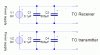
Looking at the two circuit diagrams I dont see any decoupling on the power rails.?? What I would suggest is to power each module thru its own blocking diode, say a 1N400x and decouple each module with a 22uF to 47uF cap and a 100nF. EDIT: you could just add decoupling on the cathode ends of the two 1N4007's Do you follow oK.?
__________________ Eric " Good enough is Perfect " I will NOT answer PM's requesting technical help, please use the Forum PIC tutorials: Nigel's www.winpicprog.co.uk/ Bill's: www.blueroomelectronics.com/ Last edited by ericgibbs; 25th August 2009 at 05:55 PM. | ||
| |
| | #3 |
|
I connected 0.1uf cap and 500uf electrolytic cap to transmitter and the same to receiver. The result was it still does not work. I tried to add just diodes but it did not help either. Both of schematics I added were connected to single power supply. Last edited by smilem; 25th August 2009 at 08:53 PM. | |
| |
| | #4 |
|
when u say it doesent work-what is happening when the ir is recieved by the rx unit-what happens when no ir is recieved?a scope would be handy here to see exactly what is happening when the two units are powered up but add decoupling caps across the supply for both units -what type of supply are u using to power them it may be that which is causing the problem.....
| |
| |
| | #5 | |
| Quote:
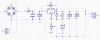
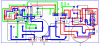
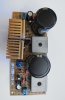
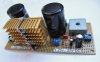
I attach my PSU schematics and photo. | ||
| |
| | #6 |
|
I can't see why you want either such a big power supply or dual supplies. Have you got anything else connected to the transmitter and receiver? If so, there could be a problem with connected power supplies. How are you powering the two AC inputs on your power supply? To run them from separate sides of a centre tapped transformer would be wrong. The receiver is just looking for any variation in light levels, and it will also operate when there is noise on the power supply. That will make it fail to detect a break in the beam. Power supply noise could come from the power supply or from the transmitter. Either way, you should isolate the receiver from that noise with something like a 10 Ω resistor in series, close to the receiver. That, along with the 1000 µF capacitor in the receiver (C5, shown near the buzzer) should remove noise at the frequencies that the receiver is sensitive to. Does it work when both transmitter and receiver are on one battery? Does it work when the transmitter is running from your power supply and the receiver is running from a battery? Does it work when the receiver is running from your power supply and the transmitter is running from the battery? When you have done all those tests, does it still work when receiver and transmitter are running from separate batteries, or have you blown something?
__________________ http://nottheboss.wordpress.com/ | |
| |
| | #7 | ||||||||
| Quote:
The second PSU will be used to power the motor via PWM driver. I made separate supplies to reduce noise. Quote:
Quote:
Quote:
Quote:
Quote:
Quote:
Quote:
from separate bateries.Do I need to do this? http://www.williamson-labs.com/480_dec.htm What RFC choke and capacitor I need? Last edited by smilem; 26th August 2009 at 12:14 PM. | |||||||||
| |
| | #8 |
|
Well I tried to connect transmitter on wall adapter and receiver on another wall adapter (the design includes DC jack). Guess what it does not work. Or should I say the receiver does not react when beam is cut meaning the buzzer makes short beep while switching on? When if working right the buzzer should be on.
Last edited by smilem; 26th August 2009 at 10:46 PM. | |
| |
| | #9 |
|
I solved the problem: D It seems the wires to IR sensor and IR LED were too close together and interference from the wires made the problems I described. It worked fine from battery, but not from any kind of power supply. I resolved the problem by using microphone shielded pair cable to connect the both leds to their circuit boards. Now it works as expected. | |
| |
|
| Tags |
| barrier, light, module, power, run, source |
| Thread Tools | |
| Display Modes | |
| |
Similar | ||||
| Title | Starter | Forum | Replies | Latest |
| Run a fan from 10-60 seconds when power is applied (noob) | TippyG | Electronic Projects Design/Ideas/Reviews | 5 | 24th June 2009 09:41 PM |
| Run multiple motors off a single power source? & Slow them down? | Skara | General Electronics Chat | 16 | 22nd April 2008 10:49 PM |
| Can LEDs run as tail light on 12VAC bitbike? | surfsand | Electronic Projects Design/Ideas/Reviews | 11 | 15th December 2007 12:01 AM |
| Solar power to run reptile enclosures... | Night0wl | Alternative Energy | 11 | 24th July 2006 11:31 AM |
| IR Light Source | steve83 | General Electronics Chat | 12 | 9th July 2006 12:08 AM |