Hey there !
Seems like a very nice forum !
I never posted anything about electronics, I usually figured my things out even if I rarely do projects like this.
Basically, it's a very simple project, but I thought the advice of people who know a lot in electronics in a place like here would be wise - before ordering all my pieces !
What I wanna do is very simple. It's to basically replace my normal front bulb light on my bicycle by a prebuild LED light ( something like this ):
**broken link removed**
I got some pretty good knowledge in electronics, so feel free to elaborate.
First here's a link of the circuit I wanna build for my dynamo LED light for my bicycle. It seems like a pretty good base to start, and also to optimize it - I'll probably start with something like this website shows :
Dynamo LED Light Systems for Bicycles (electronic circuits)
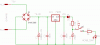
There seems to be interesting options in the evolution of the circuit shown, but I was thinking about starting with Circuit 2. Here it is for quick view of it :
**broken link removed**
I'll most probably be adding some stuff to it, but let's start with this one for my main question ....
The role of C1 ( 1000uF - 10000uF ) in this one is supposed to be only for making sure the light is constant according to the author on the website.
I was wondering however, if I replace that cap with a super cap, something like 1 Farad for example - would the cap act as a power buffer also ? Like - without modifying the circuit at all ?
This is for, when I stop completly, the light can stay on for couple of minutes ( that is after charging it a little while of course )
I found some cap for sell on ebay ... I guess I can link it ... :
**broken link removed**
Like you may have seen, those are 5.5V max ... my bottle dynamo on my bike is a 6V generator.
I thought it would still be okay, since with that circuit there's at least 1 diode in the way, dropping the voltage of about 0.7V - making it 5.3V or less - am I right ? So this wouldn't be a problem ?
Or does the fact that the dynamo is going faster on high speeds will get the voltage much higher and therefor needing more resistant components ? ( I didn't check the power output of it with a meter I gotta admit )
I was thinking of using a 3 X AA battery flashlight anyway - which is 4.5V if I'm not mistaken ( like linked above ).
Also - out of curiosity - if I just stack the 1 Farad cap, right in parallel with C1, would this increase the duration of the "power buffer" - therefor increasing the length time of lighting after stopping ? Or something bit more special needs to be done ?
So !
How does this sound til now, will this work ? Or do I need to do something special to get a decent amount of time of charge ?
I'll keep it at is for now I don't wanna make a to big post to start - wishing to increase the number of people posting advice lol
If you need any additional info to comment just ask, I'll be glad to post them, even though everything I could thought of useful.
Thanks in advanced !
I'll keep an update of what I come up with, whatever happens.
Hey there !
Seems like a very nice forum !
I never posted anything about electronics, I usually figured my things out even if I rarely do projects like this.
Basically, it's a very simple project, but I thought the advice of people who know a lot in electronics in a place like here would be wise - before ordering all my pieces !
What I wanna do is very simple. It's to basically replace my normal front bulb light on my bicycle by a prebuild LED light ( something like this ):
**broken link removed**
I got some pretty good knowledge in electronics, so feel free to elaborate.
First here's a link of the circuit I wanna build for my dynamo LED light for my bicycle. It seems like a pretty good base to start, and also to optimize it - I'll probably start with something like this website shows :
Dynamo LED Light Systems for Bicycles (electronic circuits)
There seems to be interesting options in the evolution of the circuit shown, but I was thinking about starting with Circuit 2. Here it is for quick view of it :
**broken link removed**
I'll most probably be adding some stuff to it, but let's start with this one for my main question ....
The role of C1 ( 1000uF - 10000uF ) in this one is supposed to be only for making sure the light is constant according to the author on the website.
I was wondering however, if I replace that cap with a super cap, something like 1 Farad for example - would the cap act as a power buffer also ? Like - without modifying the circuit at all ?
This is for, when I stop completly, the light can stay on for couple of minutes ( that is after charging it a little while of course )
I found some cap for sell on ebay ... I guess I can link it ... :
**broken link removed**
Like you may have seen, those are 5.5V max ... my bottle dynamo on my bike is a 6V generator.
I thought it would still be okay, since with that circuit there's at least 1 diode in the way, dropping the voltage of about 0.7V - making it 5.3V or less - am I right ? So this wouldn't be a problem ?
Or does the fact that the dynamo is going faster on high speeds will get the voltage much higher and therefor needing more resistant components ? ( I didn't check the power output of it with a meter I gotta admit )
I was thinking of using a 3 X AA battery flashlight anyway - which is 4.5V if I'm not mistaken ( like linked above ).
Also - out of curiosity - if I just stack the 1 Farad cap, right in parallel with C1, would this increase the duration of the "power buffer" - therefor increasing the length time of lighting after stopping ? Or something bit more special needs to be done ?
So !
How does this sound til now, will this work ? Or do I need to do something special to get a decent amount of time of charge ?
I'll keep it at is for now I don't wanna make a to big post to start - wishing to increase the number of people posting advice lol
If you need any additional info to comment just ask, I'll be glad to post them, even though everything I could thought of useful.
Thanks in advanced !
I'll keep an update of what I come up with, whatever happens.
Hey there !
Seems like a very nice forum !
I never posted anything about electronics, I usually figured my things out even if I rarely do projects like this.
Basically, it's a very simple project, but I thought the advice of people who know a lot in electronics in a place like here would be wise - before ordering all my pieces !
What I wanna do is very simple. It's to basically replace my normal front bulb light on my bicycle by a prebuild LED light ( something like this ):
**broken link removed**
I got some pretty good knowledge in electronics, so feel free to elaborate.
First here's a link of the circuit I wanna build for my dynamo LED light for my bicycle. It seems like a pretty good base to start, and also to optimize it - I'll probably start with something like this website shows :
Dynamo LED Light Systems for Bicycles (electronic circuits)
There seems to be interesting options in the evolution of the circuit shown, but I was thinking about starting with Circuit 2. Here it is for quick view of it :
**broken link removed**
I'll most probably be adding some stuff to it, but let's start with this one for my main question ....
The role of C1 ( 1000uF - 10000uF ) in this one is supposed to be only for making sure the light is constant according to the author on the website.
I was wondering however, if I replace that cap with a super cap, something like 1 Farad for example - would the cap act as a power buffer also ? Like - without modifying the circuit at all ?
This is for, when I stop completly, the light can stay on for couple of minutes ( that is after charging it a little while of course )
I found some cap for sell on ebay ... I guess I can link it ... :
**broken link removed**
Like you may have seen, those are 5.5V max ... my bottle dynamo on my bike is a 6V generator.
I thought it would still be okay, since with that circuit there's at least 1 diode in the way, dropping the voltage of about 0.7V - making it 5.3V or less - am I right ? So this wouldn't be a problem ?
Or does the fact that the dynamo is going faster on high speeds will get the voltage much higher and therefor needing more resistant components ? ( I didn't check the power output of it with a meter I gotta admit )
I was thinking of using a 3 X AA battery flashlight anyway - which is 4.5V if I'm not mistaken ( like linked above ).
Also - out of curiosity - if I just stack the 1 Farad cap, right in parallel with C1, would this increase the duration of the "power buffer" - therefor increasing the length time of lighting after stopping ? Or something bit more special needs to be done ?
So !
How does this sound til now, will this work ? Or do I need to do something special to get a decent amount of time of charge ?
I'll keep it at is for now I don't wanna make a to big post to start - wishing to increase the number of people posting advice lol
If you need any additional info to comment just ask, I'll be glad to post them, even though everything I could thought of useful.
Thanks in advanced !
I'll keep an update of what I come up with, whatever happens.
Seems like a very nice forum !
I never posted anything about electronics, I usually figured my things out even if I rarely do projects like this.
Basically, it's a very simple project, but I thought the advice of people who know a lot in electronics in a place like here would be wise - before ordering all my pieces !
What I wanna do is very simple. It's to basically replace my normal front bulb light on my bicycle by a prebuild LED light ( something like this ):
**broken link removed**
I got some pretty good knowledge in electronics, so feel free to elaborate.
First here's a link of the circuit I wanna build for my dynamo LED light for my bicycle. It seems like a pretty good base to start, and also to optimize it - I'll probably start with something like this website shows :
Dynamo LED Light Systems for Bicycles (electronic circuits)
There seems to be interesting options in the evolution of the circuit shown, but I was thinking about starting with Circuit 2. Here it is for quick view of it :
**broken link removed**
I'll most probably be adding some stuff to it, but let's start with this one for my main question ....
The role of C1 ( 1000uF - 10000uF ) in this one is supposed to be only for making sure the light is constant according to the author on the website.
I was wondering however, if I replace that cap with a super cap, something like 1 Farad for example - would the cap act as a power buffer also ? Like - without modifying the circuit at all ?
This is for, when I stop completly, the light can stay on for couple of minutes ( that is after charging it a little while of course )
I found some cap for sell on ebay ... I guess I can link it ... :
**broken link removed**
Like you may have seen, those are 5.5V max ... my bottle dynamo on my bike is a 6V generator.
I thought it would still be okay, since with that circuit there's at least 1 diode in the way, dropping the voltage of about 0.7V - making it 5.3V or less - am I right ? So this wouldn't be a problem ?
Or does the fact that the dynamo is going faster on high speeds will get the voltage much higher and therefor needing more resistant components ? ( I didn't check the power output of it with a meter I gotta admit )
I was thinking of using a 3 X AA battery flashlight anyway - which is 4.5V if I'm not mistaken ( like linked above ).
Also - out of curiosity - if I just stack the 1 Farad cap, right in parallel with C1, would this increase the duration of the "power buffer" - therefor increasing the length time of lighting after stopping ? Or something bit more special needs to be done ?
So !
How does this sound til now, will this work ? Or do I need to do something special to get a decent amount of time of charge ?
I'll keep it at is for now
I don't wanna make a to big post to start - wishing to increase the number of people posting advice lolIf you need any additional info to comment just ask, I'll be glad to post them, even though everything I could thought of useful.
Thanks in advanced !
I'll keep an update of what I come up with, whatever happens.
Hey there !
Seems like a very nice forum !
I never posted anything about electronics, I usually figured my things out even if I rarely do projects like this.
Basically, it's a very simple project, but I thought the advice of people who know a lot in electronics in a place like here would be wise - before ordering all my pieces !
What I wanna do is very simple. It's to basically replace my normal front bulb light on my bicycle by a prebuild LED light ( something like this ):
**broken link removed**
I got some pretty good knowledge in electronics, so feel free to elaborate.
First here's a link of the circuit I wanna build for my dynamo LED light for my bicycle. It seems like a pretty good base to start, and also to optimize it - I'll probably start with something like this website shows :
Dynamo LED Light Systems for Bicycles (electronic circuits)
There seems to be interesting options in the evolution of the circuit shown, but I was thinking about starting with Circuit 2. Here it is for quick view of it :
**broken link removed**
I'll most probably be adding some stuff to it, but let's start with this one for my main question ....
The role of C1 ( 1000uF - 10000uF ) in this one is supposed to be only for making sure the light is constant according to the author on the website.
I was wondering however, if I replace that cap with a super cap, something like 1 Farad for example - would the cap act as a power buffer also ? Like - without modifying the circuit at all ?
This is for, when I stop completly, the light can stay on for couple of minutes ( that is after charging it a little while of course )
I found some cap for sell on ebay ... I guess I can link it ... :
**broken link removed**
Like you may have seen, those are 5.5V max ... my bottle dynamo on my bike is a 6V generator.
I thought it would still be okay, since with that circuit there's at least 1 diode in the way, dropping the voltage of about 0.7V - making it 5.3V or less - am I right ? So this wouldn't be a problem ?
Or does the fact that the dynamo is going faster on high speeds will get the voltage much higher and therefor needing more resistant components ? ( I didn't check the power output of it with a meter I gotta admit )
I was thinking of using a 3 X AA battery flashlight anyway - which is 4.5V if I'm not mistaken ( like linked above ).
Also - out of curiosity - if I just stack the 1 Farad cap, right in parallel with C1, would this increase the duration of the "power buffer" - therefor increasing the length time of lighting after stopping ? Or something bit more special needs to be done ?
So !
How does this sound til now, will this work ? Or do I need to do something special to get a decent amount of time of charge ?
I'll keep it at is for now
I don't wanna make a to big post to start - wishing to increase the number of people posting advice lolIf you need any additional info to comment just ask, I'll be glad to post them, even though everything I could thought of useful.
Thanks in advanced !
I'll keep an update of what I come up with, whatever happens.
Hey there !
Seems like a very nice forum !
I never posted anything about electronics, I usually figured my things out even if I rarely do projects like this.
Basically, it's a very simple project, but I thought the advice of people who know a lot in electronics in a place like here would be wise - before ordering all my pieces !
What I wanna do is very simple. It's to basically replace my normal front bulb light on my bicycle by a prebuild LED light ( something like this ):
**broken link removed**
I got some pretty good knowledge in electronics, so feel free to elaborate.
First here's a link of the circuit I wanna build for my dynamo LED light for my bicycle. It seems like a pretty good base to start, and also to optimize it - I'll probably start with something like this website shows :
Dynamo LED Light Systems for Bicycles (electronic circuits)
There seems to be interesting options in the evolution of the circuit shown, but I was thinking about starting with Circuit 2. Here it is for quick view of it :
**broken link removed**
I'll most probably be adding some stuff to it, but let's start with this one for my main question ....
The role of C1 ( 1000uF - 10000uF ) in this one is supposed to be only for making sure the light is constant according to the author on the website.
I was wondering however, if I replace that cap with a super cap, something like 1 Farad for example - would the cap act as a power buffer also ? Like - without modifying the circuit at all ?
This is for, when I stop completly, the light can stay on for couple of minutes ( that is after charging it a little while of course )
I found some cap for sell on ebay ... I guess I can link it ... :
**broken link removed**
Like you may have seen, those are 5.5V max ... my bottle dynamo on my bike is a 6V generator.
I thought it would still be okay, since with that circuit there's at least 1 diode in the way, dropping the voltage of about 0.7V - making it 5.3V or less - am I right ? So this wouldn't be a problem ?
Or does the fact that the dynamo is going faster on high speeds will get the voltage much higher and therefor needing more resistant components ? ( I didn't check the power output of it with a meter I gotta admit )
I was thinking of using a 3 X AA battery flashlight anyway - which is 4.5V if I'm not mistaken ( like linked above ).
Also - out of curiosity - if I just stack the 1 Farad cap, right in parallel with C1, would this increase the duration of the "power buffer" - therefor increasing the length time of lighting after stopping ? Or something bit more special needs to be done ?
So !
How does this sound til now, will this work ? Or do I need to do something special to get a decent amount of time of charge ?
I'll keep it at is for now
I don't wanna make a to big post to start - wishing to increase the number of people posting advice lolIf you need any additional info to comment just ask, I'll be glad to post them, even though everything I could thought of useful.
Thanks in advanced !
I'll keep an update of what I come up with, whatever happens.