+ Reply to Thread
Page 1 of 5
1 2 3 4 5 Last
Results 1 to 15 of 67

Thread: Parking Car ElectroMagnetic Sensor

  1. #1
    giusepped Okay
    Join Date
    May 2007
    Location
    nagoya,japan
    Posts
    65

    Default Parking Car ElectroMagnetic Sensor

    I saw that there is a new type of proximity sensor for parking assistance.

    I forgot almost everything of basic physics, and I am curious to know if somebody can explain how this kind of circuit runs.
    http://www.carparkingsensordirect.com
    Basically, the website says that there is an antenna on the back of the van, a adhesive antenna made of aluminium. The magnetic field varies when a wall or an object enters in the space occupied by the magnetic field.

    But I we can measure the magnetic field?
    Any help appreciated
    G


  2. #2
    ssylee Newbie
    Join Date
    May 2007
    Location
    Vancouver, Canada
    Posts
    189

    Default

    You can measure the magnetic field by using a Hall effect proximity sensor.

  3. #3
    giusepped Okay
    Join Date
    May 2007
    Location
    nagoya,japan
    Posts
    65

    Default

    To ssylee.

    Yes I know that. But they do all with the same "antenna". Did you take a look at the website I attached?
    Thanks

  4. #4
    jpanhalt Excellent jpanhalt Excellent jpanhalt Excellent jpanhalt Excellent jpanhalt Excellent jpanhalt Excellent
    Join Date
    Jun 2006
    Location
    Cleveland, OH, USA
    Posts
    1,589

    Default

    The site doesn't really tell how it works. I doubt it is magnetic. It may be capacitative. Search on capaciflector, which has a detection range of about what is claimed. John

    Edit: Here are some references from a NASA report. I am reluctant to put the whole report, as it is about 500K.
    “Capaciflector Technology Applications,” [Online Document], 2003 Dec 10, [cited 2005 Feb 01], Available HTTP: http://capaciflector.gsfc.nasa.gov/applications.html
    “John Vranish, Electrical Engineer, GODDARD SPACE FLIGHT CENTER,” [Online Document], 1998, [cited 2005 Feb 01], Available HTTP: http://academy.gsfc.nasa.gov/1998/ht...n_vranish.html
    “The "Capaciflector" Proximity Sensor,” [Online Document], Date Unknown, [cited 2005 Feb 01], Available HTTP: http://www-cdr.stanford.edu/Touch/pr...ciflector.html
    “Capaciflector Technology Description,” [Online Document], 2003 Dec 10, [cited 2005 Feb 01], Available HTTP: http://capaciflector.gsfc.nasa.gov/description.html
    “Capaciflector Technology Benefits,” [Online Document], 2003 Dec 10, [cited 2005 Feb 01], Available HTTP: http://capaciflector.gsfc.nasa.gov/benefits.html
    Last edited by jpanhalt; 1st November 2007 at 10:02 AM.

  5. #5
    giusepped Okay
    Join Date
    May 2007
    Location
    nagoya,japan
    Posts
    65

    Default Thank you

    Thank you very much,
    I did not know at all about it.
    I will try to build some prototype and I will tell you my results!
    G

  6. #6
    jpanhalt Excellent jpanhalt Excellent jpanhalt Excellent jpanhalt Excellent jpanhalt Excellent jpanhalt Excellent
    Join Date
    Jun 2006
    Location
    Cleveland, OH, USA
    Posts
    1,589

    Default

    I built a simple one about a year ago with a sensor that was about 7 cm long and had a detection range for my hand of 12 to 14 inches. The key to making it work, which is even mentioned in the advertisement, is to standardize or calibrate whenever you first turn it on. Good luck. John

  7. #7
    giusepped Okay
    Join Date
    May 2007
    Location
    nagoya,japan
    Posts
    65

    Default

    However, if we put an inductance as sensor the effect should be the same.
    Also coils change their inductance if an object is near.
    A long string of aluminium could be a good inductor?
    G

  8. #8
    giusepped Okay
    Join Date
    May 2007
    Location
    nagoya,japan
    Posts
    65

    Default

    No, I mistaken. The inductance changes if a metal object is close!
    G

  9. #9
    jpanhalt Excellent jpanhalt Excellent jpanhalt Excellent jpanhalt Excellent jpanhalt Excellent jpanhalt Excellent
    Join Date
    Jun 2006
    Location
    Cleveland, OH, USA
    Posts
    1,589

    Default

    A frequent contributor to this forum, Chemelec, has designed a nice, inductance-based detector for cars. See:

    http://www3.telus.net/chemelec/Proje...p-Detector.htm

    However, from my understanding of what you want to do, I don't think that is the answer. For detecting any object at distances of 15 cm or more, I think your best chance is with capacitance, ultrasound, or reflected IR/light.
    John

  10. #10
    giusepped Okay
    Join Date
    May 2007
    Location
    nagoya,japan
    Posts
    65

    Default Capaciflector

    I think to realize the sensor by using a capacitive sensor and a Wien Oscillator.
    Anyone of you have some suggestions for buildings a capacflector?
    G

  11. #11
    jpanhalt Excellent jpanhalt Excellent jpanhalt Excellent jpanhalt Excellent jpanhalt Excellent jpanhalt Excellent
    Join Date
    Jun 2006
    Location
    Cleveland, OH, USA
    Posts
    1,589

    Default

    For the capaciflector, see the references already given or search on the term. If you search on patents, check on John Vranish as an inventor. I found two basic approaches to it, which in the NASA reports were known by the developer's name. One is referred to as Dr. Edward Cheung's design and a very similar design by Niels Smaby (also referred to as the Stanford design) were simple and worked for me. The other design by Vranish is a little more complicated and uses frequency sweep. The simplest design was based on an op-amp (LT1057) set up as an oscillator with the capacitative sensor on the inverting input. It is shown in the NASA reports.

    You can also check out a series of devices form Analog Microelectronics for capacitative sensors and measurement. See:
    http://www.alldatasheet.com/datashee...ME/CAV414.html

    John

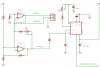
    Edit: I found this schematic of one version I made. Note: JP1 is labeled for the different capaciflector plates. The LM567 was used to detect a tone shift (i.e., object) which was the signal to other parts of the circuit.
    Attached Images
    Last edited by jpanhalt; 7th November 2007 at 09:42 AM.

  12. #12
    giusepped Okay
    Join Date
    May 2007
    Location
    nagoya,japan
    Posts
    65

    Default

    I see, thank you.
    But I mean if you have some suggestion on how to build practically the sensors, not the circuitry.G

  13. #13
    jpanhalt Excellent jpanhalt Excellent jpanhalt Excellent jpanhalt Excellent jpanhalt Excellent jpanhalt Excellent
    Join Date
    Jun 2006
    Location
    Cleveland, OH, USA
    Posts
    1,589

    Default

    The NASA publications include a student report that has a step by step procedure, including dimensions and PCB layouts, for building an obstacle avoiding robot. For the sensor I built, I just used PCB material for the conductive surfaces and clear packing tape for the dielectric layers.

    I can't be much more definite than that. The student report I referenced was done at Michigan State University (http://www.egr.msu.edu/classes/ece480/goodman/), but that site has been updated to 2007. The report you want is from November, 2004. I believe that report is still available on the NASA links. You might try to contact Prof. Goodman (the faculty advisor at MSU) directly; however, I would suggest that first you get on the internet and search the references already provided. Second, you need define better exactly what you want to do. John

  14. #14
    giusepped Okay
    Join Date
    May 2007
    Location
    nagoya,japan
    Posts
    65

    Default

    Ok, I'll take a look.
    However, my original goal is to build a simple proximity sensor for my car.
    I think to use the relaxation oscillator with its capacitor coupled with the sensor.
    The sensor should be put in the baggage van of the car and should be small.
    I think to make a long strip of aluminium and use paper as dieletric.
    G

  15. #15
    giusepped Okay
    Join Date
    May 2007
    Location
    nagoya,japan
    Posts
    65

    Default

    Quote Originally Posted by jpanhalt
    The NASA publications include a student report that has a step by step procedure, including dimensions and PCB layouts, for building an obstacle avoiding robot. For the sensor I built, I just used PCB material for the conductive surfaces and clear packing tape for the dielectric layers.
    I tried to connect to urls but they seem broken.
    May you attach a pic of your sensor?
    G

+ Reply to Thread
Page 1 of 5
1 2 3 4 5 Last

Similar Threads

  1. Car Follower/Tracker
    By eugenesiew in forum Electronic Projects Design/Ideas/Reviews
    Replies: 7
    Latest: 7th June 2009, 06:28 AM
  2. Final Year Project (DIPLOMA LEVEL)
    By eugenesiew in forum Electronic Projects Design/Ideas/Reviews
    Replies: 5
    Latest: 3rd October 2007, 04:14 PM
  3. body electromagnetic field sensor <--( help)
    By tom_electronic in forum Electronic Projects Design/Ideas/Reviews
    Replies: 4
    Latest: 19th March 2006, 01:54 AM
  4. Parking Space Detection
    By dmiga in forum Electronic Projects Design/Ideas/Reviews
    Replies: 4
    Latest: 16th June 2004, 12:05 AM
  5. Parking sensor
    By sparky098 in forum Electronic Projects Design/Ideas/Reviews
    Replies: 2
    Latest: 2nd January 2003, 09:05 AM

Tags for this Thread