Electronic Circuits and Projects Forum


DC Current limit circuit (low cost)

Results 1 to 7 of 7
Reply to Thread
  1. #1
    skinton
    skinton is offline

    Default DC Current limit circuit (low cost)

    Hi. I am new to the board and looking for a little help. I have a mechanincal background and am not very good with electrical circuits.

    I have a problem I am trying to solve. I am using a Mabuchi 24 VDC motor mounted to a gearbox. When the motor is running under "normal load", the current draw is in the .3-.5 amps range. Under a locked rotor condition, the motor is drawing around 3.5 amps. The probem is that the power source uses MOSFET transisitors that have a 1.5 amp limit. Unfortunately, I have no choice but to use the power source.

    Here is my question: is it possible to use a small inexpensive board to limit the power to 1.5 amps? I realize that when the motor is turned on, there will be a very brief spike in the current (inrush current). It would be OK it the board cut off power while the load on the motor was high enough to draw more than the 1.5 amp limit. However, when the load is removed, ideally the motor would start running again.

    If there isn't a cheap fix, I may have to search for new sources of motors.

    Thanks in advance for you help.

  2. #2
    stevez
    stevez is offline
    I know the LM317 can be configured as a current regulator though it probably adds some voltage drop. Still - take a look at the datasheet.

    Don't forget to put a fuse in if all else fails - maybe do that anyway.

    A real cheapie thing - add a power resistor in series so that the current is limited - shorting the resistor out once the motor is up and running with a switch, relay or transistor. Unless you have the stuff laying around this might not be any less expensive than the 317.

    There are likely better ways to do this but this is what comes to my mind.
    stevez

  3. #3
    Roff
    Roff is offline
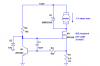
    Another fairly simple scheme is the current limiter below. It will only drop about 300mV @ 0.5A, but the MOSFET will get really hot under sustained 1.5A load.
    I calculated that the motor resistance is 24V/3.5A ~ 7 ohms. This means that, at 1.5 amps stall current, it will drop 10.5V, which puts (24-10.5)=13.5V across the current limiter. The 0.5 ohm resistor drops 0.75V, which leaves 12.75V across the MOSFET. 12.75V*1.5A ~19W. If you don't anticipate high current loads except during start-up, you won't need a really big heatsink. However, the MOSFET would then burn up if the motor did stall.
    Does anyone know what the saturation voltage of an LM317 (or LM338) is in a current limiter configuration, when the load won't support the limit? I suspect that it is close to a volt, but I don't know. That would be in addition to the drop across the current-limiting resistor, which would be about 0.85 ohms.
    I like Steve's resistor/switch combo. If you had a centrifugal switch, that would be really simple.
    None of these schemes allows maximum starting torque.

    EDIT: Added a zener from gate to GND.
    Attached Images
    Ron


  4. #4
    William At MyBlueRoom
    William At MyBlueRoom is offline
    What about using a PTC thermal fuse? They're cheap and self resetting.

  5. #5
    skinton
    skinton is offline
    Thanks for the input! I am looking at the posted solutions and doing my best to understand them. With my mechanical background, it take a little time for the circuit concept to sink in ops: . The PTC thermistor looks too simple. This would be ideal since it is only 1 small component.

    THANKS AGAIN!!!

  6. #6
    Roff
    Roff is offline
    Quote Originally Posted by skinton
    Thanks for the input! I am looking at the posted solutions and doing my best to understand them. With my mechanical background, it take a little time for the circuit concept to sink in ops: . The PTC thermistor looks too simple. This would be ideal since it is only 1 small component.

    THANKS AGAIN!!!
    Search for "self-resetting fuse". Here is one informative article from 10 years ago.
    Ron


  7. #7
    Oznog
    Oznog is offline
    Quote Originally Posted by William At MyBlueRoom
    What about using a PTC thermal fuse? They're cheap and self resetting.
    I was going to say the exact same thing. Polyfuses are GREAT little toys. Polyfuse is the main mfg of these things.

    Be aware that they do have a fair amount of DC resistance and that resistance is a bit higher in the minute or so after it resets. But larger ones have lower DC resistance thus it may be helpful to choose the largest one you can get away with.

    I wonder if it would help if you took a flat one and placed it up against the transistor, so it would trip based more on transistor overheating than just the current? Also then you might be able to get a really low DC resistance by using one rated for twice the current, like 3 amps, but when the transistor is running really hot it would still trip at 1.5amps.
    I thought what I'd do was I'd pretend I was one of those deaf-mutes.

Reply to Thread