
+ Reply to Thread
Page 1 of 2
1 2 Last
Results 1 to 15 of 20

Thread: Tiny Grid Tie Inverter Unit, Maybe.

  1. #1
    tcmtech Excellent tcmtech Excellent tcmtech Excellent tcmtech Excellent tcmtech Excellent tcmtech Excellent tcmtech Excellent tcmtech Excellent tcmtech Excellent
    Join Date
    Feb 2009
    Location
    Sawyer, North Dakota, USA
    Posts
    3,260
    Blog Entries
    2

    Default Tiny Grid Tie Inverter Unit, Maybe.

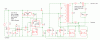
    The tiny wind generator design got me to thinking about a new possible design related to a tiny GTI.

    This one is intended as purely a proof of concept design. That is its just for the fun of it!

    The intended working range is for the 25 - 100 watt 12 volt solar power systems. The intended highest efficiency sweet spot is intended to work at around the 12-15 volt area. With hopefully 50% or better peak efficency!

    However I can either build it and debug it with the standard hands on method or I thought someone here that is good with the simulation software may be nice enough to debug it and correct the errors and mistakes and or change the values I estimated at and get and actual numbers to work with.

    Like I said this is a just for the fun of it and proof of concept design.

    Here is the basic specs.

    T1 power transformer. 120:20 ct 25 - 100 VA
    U2, U3 : transistor Opto coupler
    Q1,Q2 : 10 - 40 amp 600 volt IGBT
    555 timer: 5 -10 second delay
    SSR,TR1 : standard 10 amp solid state switch.

    Not sure if my R1 - R3, C1 - C3 snubber circuit numbers are close though.
    Same with C7 as a voltage reference current limiting device for the U2 & U3 Opto couplers.
    Attached Images
    "When in doubt, LIGHT IT ON FIRE AND SEE WHAT COLOR OF SMOKE IT CAN MAKE!" -- tcmtech


  2. #2
    SPDCHK Excellent SPDCHK Excellent SPDCHK Excellent SPDCHK Excellent SPDCHK Excellent
    Join Date
    May 2006
    Location
    South Africa
    Posts
    298

    Default

    TCM,

    Maybe it's just me, but the output of the 555 (Pin 3) does not seem to be going anywhere except to fire an opto-isolator (you called SSR). The output triac is not connected. It seems to be connected to the TR1 on the output 120V line. Is this correct?
    Don’t argue with idiots.......they will drag you down to their level and then beat you with experience!

  3. #3
    tcmtech Excellent tcmtech Excellent tcmtech Excellent tcmtech Excellent tcmtech Excellent tcmtech Excellent tcmtech Excellent tcmtech Excellent tcmtech Excellent
    Join Date
    Feb 2009
    Location
    Sawyer, North Dakota, USA
    Posts
    3,260
    Blog Entries
    2

    Default

    I didn't have an exact schematical representation of a full optically isolated solid state relay so I just did the note to show I was representing TR1 and the SSR component as as a full SSR device.

    I cheated a little. Just asume the SSR device and the TR1 are a standard 3- 32 volt DC control - 270VAC 5 - 10 amp SSR in one package.

    Sorry for the confusion.
    "When in doubt, LIGHT IT ON FIRE AND SEE WHAT COLOR OF SMOKE IT CAN MAKE!" -- tcmtech

  4. #4
    Mr RB Excellent Mr RB Excellent Mr RB Excellent Mr RB Excellent Mr RB Excellent Mr RB Excellent Mr RB Excellent
    Join Date
    Jul 2008
    Location
    Out there
    Posts
    1,757

    Default

    I like it.

    Tiny grid tie is cool.

    I would change your opamp cct by adding a resistor in the positive feedback to add a little hysteresis, ie on=13.8v off=13.3v. I think you'll get best efficiencies that way.

  5. #5
    tcmtech Excellent tcmtech Excellent tcmtech Excellent tcmtech Excellent tcmtech Excellent tcmtech Excellent tcmtech Excellent tcmtech Excellent tcmtech Excellent
    Join Date
    Feb 2009
    Location
    Sawyer, North Dakota, USA
    Posts
    3,260
    Blog Entries
    2

    Default

    Thanks!
    I couldn't sleep the other night and pondered on how to improve a simple 100 watt unit I built a few years ago.
    I just thought I would post a basic concept circuit and see what we all could come up with in refining it.
    I Figured it may get some positive interest due to so many people working with smaller solar power set ups.

    I think that by using CMOS IC's and a little tweaking the control and switching functions could possibly be reduced to under 50 Milliwatts.

    If the IGBT gate drive circuit shows a reasonably sharp turn on and turn off transition the switching loss should be very small too. The only big efficiency loss should be the transformer itself.

    If anyone has any schematics changes or refinements post them! It will help me and everyone else to see the evolution of this from theoretical concept to an efficient workable design.
    "When in doubt, LIGHT IT ON FIRE AND SEE WHAT COLOR OF SMOKE IT CAN MAKE!" -- tcmtech

  6. #6
    Martin Powell Newbie
    Join Date
    May 2009
    Posts
    2

    Default

    This Circuit seems very cool and I intend to build it
    not sure if square waves are the best way to input back into the grid ????

  7. #7
    tcmtech Excellent tcmtech Excellent tcmtech Excellent tcmtech Excellent tcmtech Excellent tcmtech Excellent tcmtech Excellent tcmtech Excellent tcmtech Excellent
    Join Date
    Feb 2009
    Location
    Sawyer, North Dakota, USA
    Posts
    3,260
    Blog Entries
    2

    Default

    The LC type tank filter plus the transformer work as fair wave form shaper.
    I have never had much problems with any AC line noise if the filter is designed right.

    I dont know if this circuit will actually work very well or if at all.
    I have yet to build one and debug it.
    There are a number of component values I have on it that may be way off!
    I just went by theoretical formula calculations. And I never ever trust theoretical math. Its a big fat liar more often than not!

    So be prepared for some fine tuning!

    I will try and get around to building it one of these days too.
    "When in doubt, LIGHT IT ON FIRE AND SEE WHAT COLOR OF SMOKE IT CAN MAKE!" -- tcmtech

  8. #8
    Existenz_69 Newbie
    Join Date
    May 2009
    Posts
    6

    Default

    Speaking of small circuits... On smaller circuits like this would the Texas Instruments TPS68000DBT be an alternative choice since it "claims" to have pure sinewave and drives a true h-bridge? I found a schematic for a full-bridge CCFL controller that looks much like the inverters we are trying to build only much smaller and minus the CCFL lamp. I found the analog dimming interesting. May be totally useless for our needs though (probably is since i found it... )Check out the PDF below... I tried building yours in cadsoft eagle 5.4 professional and it seems to crash my pc after autoroute command so i couldn't export it. I wasn't trying to SIM, but to check for errors and lay out the traces for the board. Thanks.
    Attached Files

  9. #9
    Martin Powell Newbie
    Join Date
    May 2009
    Posts
    2

    Default

    Looking at your pdf file seems like this would be ok to step up the dc voltage with a few extra mods
    Then you would have to convert it to dc then use a 2nd h bridge to convert to Ac and use a PWM to control 2nd H bridge.

    Has anyone input mains 50hz into a PWM via a coupling transformer to control power Fets
    And thereby put simulated sine wave back into the grid this way only needs a small filter and
    Must be more efficient.

  10. #10
    tcmtech Excellent tcmtech Excellent tcmtech Excellent tcmtech Excellent tcmtech Excellent tcmtech Excellent tcmtech Excellent tcmtech Excellent tcmtech Excellent
    Join Date
    Feb 2009
    Location
    Sawyer, North Dakota, USA
    Posts
    3,260
    Blog Entries
    2

    Default

    Interesting Idea.
    I have also been thinking about how to use a Class D type audio amplifier IC to drive the H-Bridge in order to get a very clean sine wave just for greater overall efficiency though. This is the class D amp IC I was planning on experimenting with some time. I would just use the outputs to drive a set of IRF2110 or similar high/low side driver IC's that run the line side connected H-Bridge.

    I am not one that cares much about output filter size. The output filtering that I have been using is not all that large in comparison to the rest of the GTI device. Just a the right size PFC capacitor and a basic dual choke AC line filter with the right amp capacity has shown it works just fine. Or at least with the low frequency transformer design it does.

    I also think that by using a line side coupled op amp with all of its power and control circuits placed on the line side of the GTI it should be able to directly sample the line side wave form and feed it directly to the amplifier IC. That way the slight phase lag is brought down to less than a degree or so.

    The input power source could then just be a simple fly-back or some type of switching inverter (Modified store bought inverter?) to take the variable input voltage and power available and then isolate and step it up to the line voltage levels that would supply the actual power to the H-bridge.

    The down side to all of this is the overall complexity of the added switcher inverter isolation efficiency, 80 - 85% typical, plus the class D H-bridge drive and other factors dont add up to much greater overall efficiency gains or a overall improvement in line side wave form.
    But the cost and complexity goes up.

    If the input power source could be electrically isolated and was putting out a voltage high enough to run at line level voltages then the switching inverter isolation could be removed. I can see a theoretical GTI efficiency that would easily get into the 90 - 95+% overall peak operation efficiency. Maybe.

    Theoreticaly speaking of course.
    Attached Files
    "When in doubt, LIGHT IT ON FIRE AND SEE WHAT COLOR OF SMOKE IT CAN MAKE!" -- tcmtech

  11. #11
    killivolt Excellent killivolt Excellent killivolt Excellent killivolt Excellent killivolt Excellent killivolt Excellent killivolt Excellent killivolt Excellent
    Join Date
    Mar 2008
    Location
    U.S.
    Posts
    1,597

    Default Very Cool

    Thanks, I sort of understand the process now. I'm going to have to get some reading in to understand how the ssr package how it works on the back end of things.

    Once I get that then how the front end works and what the 555 timer is doing if it's an LC tank then it's doing something to the input voltage ? I just don't know what except maybe filtering the voltage smoothing it? or something is my guess.

    I'll just keep following the thread. Interesting input on the Texas Instrument application seems your getting people thinking TCM.


    kv
    General Thade: Is there a soul in there?

  12. #12
    tcmtech Excellent tcmtech Excellent tcmtech Excellent tcmtech Excellent tcmtech Excellent tcmtech Excellent tcmtech Excellent tcmtech Excellent tcmtech Excellent
    Join Date
    Feb 2009
    Location
    Sawyer, North Dakota, USA
    Posts
    3,260
    Blog Entries
    2

    Default

    The SSR is just the line connection switch. Nothing more. it could easily just be a mechanical relay too.

    The 555 timer is just a time delay for the on/off connection to the line. It lets the GTI stay connected during short input power drops of a few seconds.
    That way its not constantly connecting and disconnecting if the input voltage is not smooth. (shadows moving across solar panels)
    "When in doubt, LIGHT IT ON FIRE AND SEE WHAT COLOR OF SMOKE IT CAN MAKE!" -- tcmtech

  13. #13
    killivolt Excellent killivolt Excellent killivolt Excellent killivolt Excellent killivolt Excellent killivolt Excellent killivolt Excellent killivolt Excellent
    Join Date
    Mar 2008
    Location
    U.S.
    Posts
    1,597

    Default

    I've gotta head out I'm glad you responded. Now I get it.


    Back in the day. I went into Refrigeration and Air Conditioning as they said you will need this to go into the Solar Energy Field "right" Bullsh...... That put me on the wrong road from the git go. Now I make up for lost time trying to learn Electronics.

    Rant: I should have had this all down back then. Just pisses me off when I ignorantly believe in lie's. But then again that's life.


    Thanks for the help.


    kv
    General Thade: Is there a soul in there?

  14. #14
    Existenz_69 Newbie
    Join Date
    May 2009
    Posts
    6

    Default

    Quote Originally Posted by Martin Powell View Post
    Looking at your pdf file seems like this would be ok to step up the dc voltage with a few extra mods
    Then you would have to convert it to dc then use a 2nd h bridge to convert to Ac and use a PWM to control 2nd H bridge.

    I was mainly thinking of using the only TPS68000 to drive a moderate h-bridge, or using it to drive some small fets or the like for driving a larger h-bridge. That schematic was a full dc/ac inverter, but was using a HV transformer as the power transformer. I was hoping that one might be able to use the analog dimming feature to control the output current/voltage, or frequency. One could easily adapt this IC to a higher power setup with a few small mods, and hopefully keep the true sine. The only trick would be the phasing.

  15. #15
    rx5
    rx5 is offline
    rx5 Newbie
    Join Date
    May 2006
    Location
    Leyte, Philippines
    Posts
    16

    Default

    Quote Originally Posted by tcmtech View Post
    The tiny wind generator design got me to thinking about a new possible design related to a tiny GTI.

    This one is intended as purely a proof of concept design. That is its just for the fun of it!

    The intended working range is for the 25 - 100 watt 12 volt solar power systems. The intended highest efficiency sweet spot is intended to work at around the 12-15 volt area. With hopefully 50% or better peak efficency!

    However I can either build it and debug it with the standard hands on method or I thought someone here that is good with the simulation software may be nice enough to debug it and correct the errors and mistakes and or change the values I estimated at and get and actual numbers to work with.

    Like I said this is a just for the fun of it and proof of concept design.

    Here is the basic specs.

    T1 power transformer. 120:20 ct 25 - 100 VA
    U2, U3 : transistor Opto coupler
    Q1,Q2 : 10 - 40 amp 600 volt IGBT
    555 timer: 5 -10 second delay
    SSR,TR1 : standard 10 amp solid state switch.

    Not sure if my R1 - R3, C1 - C3 snubber circuit numbers are close though.
    Same with C7 as a voltage reference current limiting device for the U2 & U3 Opto couplers.
    @tcm

    HOW do you drive the IGBTs if I just power it up from a 12V source? I mean I can see you get (isolated)gate drives from the output of the transformer.. OR is that it? I mean feeding its own output to sustain oscillation?

+ Reply to Thread
Page 1 of 2
1 2 Last

Similar Threads

  1. Grid Tie Inverter Schematic
    By Burnt in forum Alternative Energy
    Replies: 245
    Latest: 8th January 2010, 07:36 AM
  2. 250 watt grid tie inverter build
    By Robby in forum Alternative Energy
    Replies: 113
    Latest: 13th August 2009, 06:19 PM
  3. Cheap Grid Tie Inverter Manufacturer
    By zicmama in forum Alternative Energy
    Replies: 4
    Latest: 2nd May 2009, 07:09 PM
  4. LED Grid Display project
    By Peepsalot in forum Micro Controllers
    Replies: 21
    Latest: 25th March 2006, 07:12 PM
  5. Power Distribution Unit 0 Unit?
    By shermaine in forum General Electronics Chat
    Replies: 4
    Latest: 15th June 2005, 06:59 AM

Tags for this Thread