![]() | ![]() | ![]() |
| |||||||
| General Electronics Chat This forum is for general chat about electronics, eg: Dont know what a part does? Dont know how to read a circuit? Want to get an opinion? |
![]() |
| | Tools |
| | #1 |
|
hello everyone, i'm currently planning to make my own solenoid Magnet as prototype on my project. this will serve as a "magnet lock" for my electronic door with pin code as access. the reason im asking you experts on electronics its because i nearly burn down our house due to miss calculations on creating one and following various instructions over the web. things at hand: 28-guage wire (100grams) i'm planning to make a solenoid magnet that could work on 24volts(prototype only) which will represent as "magnet lock" any suggestions with the wire that i have right now.. hope you could help me. | |
| |
| | #2 |
|
Hi, My suggestion is dont try to wind one yourself but rather buy one already made. This will save you lots and lots of headaches. Last edited by MrAl; 7th November 2009 at 12:41 PM. | |
| |
| | #3 |
|
Cost of House: $150,000 Cost of commercially available solenoid: $50.00 Keeping your family and possessions safe: PRICELESS What Mr. Al said, ditto. To make what you want to make properly you honestly need a properly tooled machine shop as well as the wire for the coil. Or at least the ability to have it made for you. Materials and time could EASILY exceed the cost of a prefabricated solenoid. If you were building some little hobby project, like a small robot or something like that, it might be well worth it to build this type of thing simply because Its use and function would always be under controlled, observed conditions. A door lock would be energized, I assume, during times when you are away from home and asleep. All of these reasons, along with the fact an insurance company will likely not honor your policy in the event of a fire are reasons to do it the right way. | |
| |
| | #4 |
|
There are any number of used electronics devices that you can get solenoids from. A toaster being the first one that comes to mind. Most simple toasters have a solenoid wired directly to a thermo couple which pops the lever that causes the toast to come up when it's been heated enough. They'll trigger on extremely low voltages and will provide incredible torque for brief pulses, perfect for a locking mechanism that doesn't need to actuate frequently.
__________________ "Because I be what I be. I would tell you what you want to know if I could, mum, but I be a cat, and no cat anywhere ever gave anyone a straight answer, har har." Last edited by Sceadwian; 7th November 2009 at 05:35 PM. | |
| |
| | #5 |
|
though buying a ready made one would be a solution to you, i appriciate your interest to make one, if you work by trial and error method. you have 28SWG see whats its rating, select 80% of the rating as your design, then calculate the DC resistance of the solenoid to make that rated current. ie: R= V/ 0.8XRating (only for DC application) now your winding should have the same R as calculated(wind the coil until you measure this resistance value between terminals). so the flux your solenoid would produce is as number of turnsx current (0.8 rated) since you have to stick on the resistance of the coil the size and the strength of the magnet may be too big or very small for your need. in this case you have to slect another size of wire and rating... repeat as above until you get the correct one to give good result. to summerise. the voltage and the size of the coil decides everything for a particular solenoid. other method but in practice we do it in reverse...the 1st selection is the strength required, then the size of the solenoid(ampere turns) , then depends on the voltage the coil is being slected. to work on this you need more accurate information not like the 1st method. Last edited by mbarazeen; 7th November 2009 at 08:57 PM. | |
| |
| | #6 |
|
One question that did come to mind about your solenoid project, which is very elementary but could be CRITICAL to your outcome. Please tell us about your wire.Is it insulated or bare copper? Solenoid coils are wound with enamel, resin, or some other insulation material. You mentioned almost burning down your home. Yep, that would happen if you used bare copper wire. Might be a pretty flame for a good bit! Forgive me if this question sounds like it belittles your intelligence, but believe me we can't take anything for granted! | |
| |
| | #7 |
|
100g of AWG 28 wire is about 450 feet; and its resistance is about 30 ohms. At 24V, it will carry 0.8 A. It would dissipate 19 Watts, which will make it very hot. In open air, 28AWG should carry 0.2A, and should be derated for a coil. SWG 28 is slightly heavier, decreasing the resistance accordingly, drawing more current and becoming even hotter. It will burn your house down again.
__________________ de KI6RWX Last edited by mneary; 7th November 2009 at 10:26 PM. | |
| |
| | #8 |
|
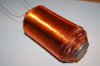
Please don't burn your house down. I would suggest using 21 gauge magnet wire. This wire can take 200 Degree C, give or take depending on the manufacturer. Making one that doesn't overheat too quickly is not hard. The homemade one in the picture uses 21 gauge wire and I used it on a 12v circuit. Never got hot. Felt like one of those heat packs from the pharmacy after an hour. Its not the strongest magnet in the world, but it's not terrible. Cheap-yes Efficient-definitely No Safe-I say yes, but hesitate because you can never make things stupid proof Gets the job done-yes Easy to make-not really Your best bet is too buy one. Picture is just an example, I'm guessing yours would be smaller. Last edited by Njguy; 7th November 2009 at 11:09 PM. | |
| |
| | #9 |
|
Heavier wire helps with the current handling capability but you need a lot of it to have a resistance that keeps the current drain reasonable. Lower voltage helps, too. For example, a solenoid with AWG 21 wire which draws 500mA from 12V, weighs almost 1kg.
__________________ de KI6RWX | |
| |
| | #10 |
|
Determine your needed resistance that will keep the coil cool (from whatever gauge wire), and then according to your size limitations, pick the smallest gauge wire and use the amount of it (length) that the ohms per length matches. This will give you the same current draw as any other larger gauge wire, take less space and cost less, as well as allowing it to short & break without it first heating up an incredible amount. You'll be much less likely to get to the point of the wire actually sparking. Last edited by madhippiescientist; 8th November 2009 at 07:45 AM. | |
| |
| | #11 | |
| Quote:
| ||
| |
| | #12 |
|
update on my project: ive created a SOLENOID LOCK using a #25 magnet wire(150grams) enough to sustain heat even under 24hrs of use. under 220volts(AC) - i used the idea of a magnetic conductor of machine which it has a movable core ive use #28 magnet wire(100grams) for my buzzer | |
| |
| | #13 |
|
calculation for AC solenoid are different from DC, for a same voltage AC requires less number of turns.
| |
| |
| | #14 | |
| Quote:
Hi there, Sounds very interesting. I wouldnt mind seeing a photograph of that construction. What did you use for the core and the plunger? | ||
| |
| | #15 | |
| Quote:
Sorry for the CLAIM: its still doesn't work. materials used: 10mm in diameter bolt (steel bolt) 250grams of AWG 220AC power source it gains very high temperature in less than 2mins. the bolt(plunger) is very hot also(steel) any suggestions? thank you | ||
| |
|
| Tags |
| magnet, make, solenoid |
| Thread Tools | |
| Display Modes | |
| |
Similar | ||||
| Title | Starter | Forum | Replies | Latest |
| electro magnet | balachandran.001 | General Electronics Chat | 5 | 9th May 2009 08:02 PM |
| How to make solenoid as in reverse operation? | xiaobai00 | Electronic Projects Design/Ideas/Reviews | 18 | 29th November 2007 10:56 PM |
| magnet? | rumiam | Alternative Energy | 5 | 25th April 2007 09:02 PM |
| Magnet Questions | PapaSmurf | General Electronics Chat | 16 | 26th April 2006 03:27 AM |
| magnet theory | walters | General Electronics Chat | 163 | 7th January 2006 03:38 PM |