Electro Tech is an online community (with over 170,000 members) who enjoy talking about and building electronic circuits, projects and gadgets. To participate you need to register. Registration is free. Click here to register now.
Welcome to our site! Electro Tech is an online community (with over 170,000 members) who enjoy talking about and building electronic circuits, projects and gadgets. To participate you need to register. Registration is free. Click here to register now.
i know both of them from school but there is something i dont understand!!!
please tell me when we have to use a BJT and when a mosfet! is it bad idea to use a buz11 as switch for a small fan?
Very time-sensitive switching applications benefit from the BJT's lesser capacitance, but MOSFETs have more thermal stability and can act as precision resistors. That's all I can think of, I'm not too experienced as of yet.
i think mosfets require voltage and not current to become open but how much voltage? also a mosfet as switch controls better a device that needs much current or much voltage?
Depends how you classify this and in what applications. Nowdays because of the simplicity and ubiquity of the fabrication process for MOSFETs and the miniturisation capabilities of the MOSFET (particularly when compared to BJTs), particularly in ICs and MSI, LSI and VLSI systems, MOSFET is the device of choice. Given MOSFETs in VLSI systems might total several hundred million on a single chip I would suggest that MOSFETs are by far more common than BJTs in both numbers and application diversity.
For discrete transistors the situation may be different.
MOSFETs can generally switch faster (they certainly require less complex and less pwoer to drive their gates). But if I'm not mistaken, BJTs designed for the task can switch very very fast since they have no gate capacitance to charge and can also operate in quasi-saturation mode for even faster switching at the expense of conduction efficiency. MOSFETs have less losses when used as a switch at "lower" voltages (lower as in industry's definition which is <~200V).
MOSFETs act like a resistor when on while BJTs act more like diodes. The resistance can be modified by changing the "dimensions" of the MOSFET while the BJT's "diode voltage drop" can't be changed so easily unless the materials are changed. THis tends to make MOSFETs have less losses at the lower voltages but also means MOSFETs can be paralleled since current imbalances will cancel out.
With parallel BJTs, the best BJT will hog the current from the other "not so good BJTs" and burn out and the cycle repeats with the remaining BJTs until they are all burned. This is similar to parallel diodes. You can correct for imbalances by manually tuning resistors in series with each BJT, but for power applications that's needing massive resistors and wasting lots of power.
With parallel BJTs, the best BJT will hog the current from the other "not so good BJTs" and burn out and the cycle repeats with the remaining BJTs until they are all burned. This is similar to parallel diodes. You can correct for imbalances by manually tuning resistors in series with each BJT, but for power applications that's needing massive resistors and wasting lots of power.
You don't need to 'manually tune' the resistors, you just use identical values in order to make them share the current equally. This is also essential on some types of audio output FET's as well - essentially it's because of the different temperature coefficients of the types of devices.
But you don't need massive resistors, or waste huge amounts of power, you only need to drop a couple of hundred mV.
Is it true to say that Mosfets is much less forgiving and less idiot proof?
That they ideally need a mosfet driver?
and they are more prone to static dammages?
Is it true to say that Mosfets is much less forgiving and less idiot proof?
That they ideally need a mosfet driver?
and they are more prone to static dammages?
No, I would not say MOSFETS are less forgiving. In fact they have some characteristics that make them a bit harder to work with, like self latching and their sensitivity to ESD.
The majority of MOSFETS need a 10V source on the gate-source to turn on fully. There are some logic level MOSFETS that will turn on fully at ~4.5V, some even less, but these are for smaller applications. Larger applications like motor controls, power inverters, etc. you will need a driver circuit of some sort to get them to switch fast enough.
They can handle VERY high currents, although it's very hard to find MOSFETS that can handle over 400V or so. At that point its better to go to BJTs (IGBTs for power applications) as they can handle the higher voltages easier.
My knowledge is from the power electronics point of view, fyi.
Is any component really temperature variation independent? I don't think so...
MOSFETs have a resistance R(ds)(on), the drain-source resistance when current is passing through the FET. This resistance increases with increasing temperature, usually due to increasing current. This effect is important in DC-DC converters, when high currents are passing through the FET.
I almost always use FETs - probably because that was what we used in school. If you need to use them in low voltage applications, check the threshold voltage (voltage at which the FET turns on). My favorite NFET for 3V applications is the BSS138 - cheap, and with a very low threshold voltage.
Help me out with this "fully turned on" business of FET's, as I came across this the other day. What indicates a fully turned on condition? I haven't done much in the way of power systems.
Help me out with this "fully turned on" business of FET's, as I came across this the other day. What indicates a fully turned on condition? I haven't done much in the way of power systems.
Hmmm.... yesterday we were discussing driving an IRF7201 in triode mode to drive a relay coil, and the subject of "fully on" came up. https://www.electro-tech-online.com/threads/i-need-help-choosing-a-transistor.93432/ I think AG is very knowledgable about these things, and knows what he's talking about, as do you. But I still can't get my head around the concept. BTW, I looked at the Rdson spec for the 7201, and it was specified for both VG=10V and VG=4.5V. Below 20A Drain current, Rdson was around .05Π I think for both inputs. But over ID=20A, there was significant difference. So, I assumed that was the difference between being "fully" on and just "on."
Anyway, there seems to be many ways to define what "on" is. I just need to understand the vocabulary.
If you look at the IRF7201 datasheet again, you'll notice the Rds(on) at 10V == 30mΩ, and 4.5V == 50mΩ.
Being "fully on" just means that you have hit the top(or bottom) side of the Rds(on) curve. That the resistance is about as low as it's going to go, regardless of how much more voltage you apply to the gate. There is no real set point at which this happens, and more of an acceptable point to the application at hand.
The DS shows the gate threshold voltage to be only 1V. That's when the MOSFET starts to turn on and pass current, but at a very high resistance. It's not until the gate hits ~4V that the resistance finally starts hitting an acceptable range.
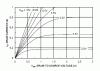
Figure 6 of the DS is showing that using only 4.5V at the gate will hit a maximum saturation of the drain-source junction due to the field not being large enough for the entire channel to conduct. It's not "fully on" yet for that amount of current. If you wanted to pass more current, you would have to drive it with a higher gate voltage.
Actually, I'm looking at an International Rectifier IRF7201 datasheet, and it appears that around Id=5A, Rds~=.025 @ 10V and ~=.035 @ 4.5V. That seems like such a small difference. However, as Id reaches around 20A, the curve for Vg=4.5V appears to spike up exponentially, while the 10V curve remains flat. IRF7201 pdf, IRF7201 description, IRF7201 datasheets, IRF7201 view ::: ALLDATASHEET :::
Would it be corret to say that under 20A, the device is "fully on" with VG=4.5V, but not at Id>20A?
This site uses cookies to help personalise content, tailor your experience and to keep you logged in if you register.
By continuing to use this site, you are consenting to our use of cookies.