Electro Tech is an online community (with over 170,000 members) who enjoy talking about and building electronic circuits, projects and gadgets. To participate you need to register. Registration is free. Click here to register now.
Welcome to our site! Electro Tech is an online community (with over 170,000 members) who enjoy talking about and building electronic circuits, projects and gadgets. To participate you need to register. Registration is free. Click here to register now.
Hi pple,
My main supply is 12V and i have a amplifer that has 9V input.
how do i step down the voltage to 9V?
I heard before a voltage spliter is there such a thing?
Sorry i am quite new at this..
You need a voltage regulator IC. The minimum voltage drop is about 2.5 to 3 V for these devices. You can use a 7809 regulator, but I suggest that you have a look at some LDO regulators (Low Drop Out), that guarantee a better regulation if the input voltage is close to the output voltage (typically 0.8 V at full current)
Hi pple,
My main supply is 12V and i have a amplifer that has 9V input.
how do i step down the voltage to 9V?
I heard before a voltage spliter is there such a thing?
Sorry i am quite new at this..
A couple of things (assume you are talking about DC voltage):
A. Is the 12 volt source exactly that or more like 13.8? While the difference may not seem like much, an extra volt helps with what eng1 mentions. If you could stick with a 7809 or LM317 it will be easier to find one.
B. What are the current requirements? Is this a preamp for RF or some kind of audio amp with significant power output. The 7809 and 317 do have limits in terms of current handling.
C. A series resistor could be used. This is only practical if the load current is very small, fairly constant and you can tolerate the lack of stability in the 9 volt supply.
In this case, if a 50 ma load is expected then a 60 ohm resistor (1/4 watt) would do the job. If it's not 50 ma then the value is quite different.
Thx for the reply pple,
stevez,
The input supply is for a regulated power supply. ~12V. as i measured.
Actually i need to integrate some speakers in my circuit but i only wanna use
one adaptor or power supply.. the speakers i used is some cheap PC speakers that requires 9V - 400mA. My main supply unit is 12V - 4A.
So i guess i just need to match it right?
so can use a 7809 or the circuits that "hotwaterwizard" has suggested?
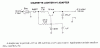
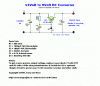
Yes, and LM7809 or buffered zenner (like hatwater wizard's) will both work. I recommend the LM7809 as it'll give you the best regulation and short circuit protection.
Since the power supply is already regulated the fluctuation will not be there. you could also just put a 3 volt light bulb in series with the 9 volt load to create a 12 volt load. An Incandescent bulb will take up the fluctuation as well. The bulb must be a larger current draw than the amplifier or it will simply act like a fuse.
Thx for the reply pple,
stevez,
The input supply is for a regulated power supply. ~12V. as i measured.
Actually i need to integrate some speakers in my circuit but i only wanna use
one adaptor or power supply.. the speakers i used is some cheap PC speakers that requires 9V - 400mA. My main supply unit is 12V - 4A.
So i guess i just need to match it right?
so can use a 7809 or the circuits that "hotwaterwizard" has suggested?
If the 12V supply is regulated why bother with 7809? Just use something like 4X1N400x diodes in series. The voltage drop acros is somewhat the same in the 50-400mA range and the circuit will generate litle heat (so no small heatsink required).
I need to step 19V/ .-022 A down to 9V, but want to do it as cheaply as possible. I think a resistor will be appropriate, but I have no idea how to calculate what size of resistor I need for this. In the future, how do I determine the appropriate resistor value when presented with this kind of problem?
This sucks. I used a 1 K ohm resistor - about the value it says to use. The 5v fan doesn't even turn. I tried connecting two 1k resistors in parallel, thinking maybe I could get more power that way, of course at this point I'm just experimenting. I don't know. What type and size of resistor should I be using here? The voltage source is 19V, and I want to bring it down to 8 or 9v using a cheap simple solution.
To step down 19V to 9V at 22mA then the resistor is (19V - 9V)/22mA= 455 ohms. I have never seen a fan that draws only 22mA.
To step down 19V to 5V for a fan then you need to know how much current the fan draws. If it draws 200mA then the resistor is (19V - 5V)/200mA= 70 ohms. The resistor will dissipate (200mA squared) x 70 ohms= 2.8W so a 5W resistor should be used.
Many of these fans aren't labeled, so how do I determine how many ohms the fan is? A 5W resistor should be used? How many ohms? 70?
Here is one of the fans that I plan to run.. It's rated at 5V / 0.38A . I know I shouldn't operate it over 5V, but I would rather throw away a $30 fan in a year or two than a $250 motherboard. So, I'm going to tap into the 19V rail off of a ceramic cap, then step the voltage down to at or around 8 volts.
Use simple arithmatic:
The resistance of the fan is about 5V/0.38A= 13.2 ohms.
The current with an 8V supply is 8V/13.2 ohms= 0.61A. The resistor value is (19V - 8V)/0.61A= 18 ohms. It dissipates (11V squared)/18 ohms= 6.7W so use a huge 10W resistor.
Umm...I wouldn't just go tapping into power from a random place on the motherboard! Your motherboard should have some connectors for plugging in fans.
If not, you could also use power from one of the outputs from your PSU. A normal Molex connector has the 5V you need coming from the red pin. Both of the blacks are ground.
Use simple arithmatic:
The resistance of the fan is about 5V/0.38A= 13.2 ohms.
The current with an 8V supply is 8V/13.2 ohms= 0.61A. The resistor value is (19V - 8V)/0.61A= 18 ohms. It dissipates (11V squared)/18 ohms= 6.7W so use a huge 10W resistor.
Use simple arithmatic:
The resistance of the fan is about 5V/0.38A= 13.2 ohms.
The current with an 8V supply is 8V/13.2 ohms= 0.61A. The resistor value is (19V - 8V)/0.61A= 18 ohms. It dissipates (11V squared)/18 ohms= 6.7W so use a huge 10W resistor.
That's awesome. I guess what I was worried about was, how do we know this is correct, if we don't know the Amperage of the 19V line? Is that irrelevant? I think you only need one (V I or R) to determine the other two.
I broke this down to make sure I understand the concepts behind it. I think I'm starting to understand.
Fan volt rating is 5v / .38A
5 divided by .38 is 13.157. Round it to 13.2
Goal is to run on 8 volts
8 (voltage you want) divided by 13.2 (ohms of device) is .60606 - round to .61 A
Tapping into a 19V rail. We don't want 19 volts. We only want 8 .
19 (voltage you have) minus 8 (voltage you want) is 11.
11 (voltage you want) divided by .61 = 18 Ohms (This is the resistor size needed)
To determine the wattage - square your new voltage, and divide it by the number of ohms
11 volts squared is 121. 121 divided by 18 (Ohms) is 6.72
So, we need a resistor capable of dissipating more than 6.72 watts. A 10 watt resistor is sufficient.
I read that there is another way to determine wattage. Current times the voltage at a given point.
The current here is .61 amps. Multiply that by 11 (the amount of voltage we plan to dissipate.)
.61 times 11 is 6.71! Everything checks out!
I'm also going to keep reading Ohm's law definitions and tutorials until it really clicks.
This site uses cookies to help personalise content, tailor your experience and to keep you logged in if you register.
By continuing to use this site, you are consenting to our use of cookies.