![]() | ![]() | ![]() |
| | |||||||
| General Electronics Chat This forum is for general chat about electronics, eg: Dont know what a part does? Dont know how to read a circuit? Want to get an opinion? |
| | LinkBack | Thread Tools | Display Modes |
| | (permalink) |
| ever since someone here (audioguru?) mentioned the use of a varicap, I have a question. what is the best diode to use as a varicap? I am using a 6V - 9V DC power supply. Sometimes battery, sometimes, a DC adapter. The frequency I am dealing with is between 100 and 200Mhz. and I want the varicap to have at least a 1pF range. I looked at the 1N914's and the datasheet shows that I can go as far as 0.2pF at 1Mhz. Is a 1N914B suitable? I also have a 1N4007 which I think is unsuitable. I don't know.
__________________ -=: The best low-priced components to troubleshoot with are the speaker and the LED :=- | |
| |
| | (permalink) |
| search for PIN-diodes | |
| |
| | (permalink) | ||||
| Quote:
Quote:
Quote:
Quote:
| |||||
| |
| | (permalink) |
| I've heard that Zener diodes make better varicaps. Maybe you will find some interesting info here: http://web.telia.com/~u85920178/tx/bug9.htm A 16V zener is used in that design. | |
| |
| | (permalink) |
| Here's a Ham article comparing various PN junction devices for their 'varicap' properties... http://www.qrp.pops.net/pnj.htm Regards, Mike | |
| |
| | (permalink) |
| MStechca, How do you figure that a capacitance change of only 1pF will cause a coil to tune from 100MHz to 200MHz? 1pF is absolutely nothing at these frequencies. The stray capacitance of connections at the coil on a pcb will be 5pF to 10pF. I calculate that a 0.1uH coil needs 25.6pF to tune 100MHz and needs 6.4pF to tune 200MHz. If the stray circuit capacitance is only 5pF, then you need a varicap with a range from 1.4pF to 20.6pF. Therefore you need a real varicap to have such a broad range.
__________________ Uncle $crooge | |
| |
| | (permalink) |
| There is an rule of thumb in regards to the capacitance range with a frequency range. In simple terms square the frequency range and you have the capacitance range. Frequency range=f2/f1 In this case Fr=200Mhz/100Mhz, Fr=2 Capacitance range =Fr x Fr or in this case 4 Confirming Audioguru's calculations 6.4pf x 4 = 25.6pf
__________________ The great thing about electronics is unlimited ways to do the job. The only limit is one\'s imagination. I generally think my way is best. Show me a different way. I have an open mind. | |
| |
| | (permalink) | ||
| Quote:
Quote:
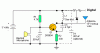
Would the following modification (see attachment) allow me to change the frequency using outputs from any digital IC, and by altering the resistor in series with the output? and what are the minimum and maximum capacitances I can obtain from the 1N4007?
__________________ -=: The best low-priced components to troubleshoot with are the speaker and the LED :=- | |||
| |
| | (permalink) |
| You might as well capacitor-couple the varicap like all other circuits so you can bias it with a positive voltage referenced to ground. It won't be connected to the tank with your coupling resistor. I guess the tank's stray capacitance is 5pF, the transistor is 3pF, the antenna is 5pF and the feedback cap adds a couple for a total capacitance without the varicap of 15pF. The capacitance of the 1N4007 is 5.5pF at 9V, 10pF at 3V and 19pF at 1V. You can calculate its limited tuning range due to the high stray capacitance in parallel with it.
__________________ Uncle $crooge | |
| |
| | (permalink) |
| Can I use the series-capacitance equation to get the resulting capacitance from the diode and the 100pF and make that my C for my LC tank? and why is the coupling capacitor so small?
__________________ -=: The best low-priced components to troubleshoot with are the speaker and the LED :=- | |
| |
| | (permalink) | ||
| Quote:
Quote:
| |||
| |
| | (permalink) |
| Hey mstecha, thats a good idea for sending digital signals over RF :lol: . Maybe I'll try it for the heck of it sometime. You do realise that in your first modification ,before audio corrected it, that your digital signal would also be changing the supply voltage.
__________________ I'm no electronics god, i just talk too much. | |
| |
| | (permalink) | ||
| so I could use 1uF if I wanted to? Quote:
Quote:
__________________ -=: The best low-priced components to troubleshoot with are the speaker and the LED :=- | |||
| |
| | (permalink) |
| Sorry, I take that back, it wouldn't be changing the supply voltage. It would just be a voltage in parallel with the battery so it wouldn't do anything to the supply voltage and I don't think the transmitter would even send a different signal. Someone correct me if I'm wrong . . .
__________________ I'm no electronics god, i just talk too much. | |
| |
| | (permalink) |
| [quote="mstechca"]so I could use 1uF if I wanted to?[quote] Why? 100pF is good enough as a coupling cap at these very high frequencies, anything over 330pF won't make a difference. You can't use a cheap electrolytic or an expensive ceramic 1uF cap because they are inductors at these high frequencies.
__________________ Uncle $crooge | |
| |