![]() |
![]() |
![]() |
|
|
|||||||
| General Electronics Chat This forum is for general chat about electronics, eg: Dont know what a part does? Dont know how to read a circuit? Want to get an opinion? |
|
|
Thread Tools | Display Modes |
|
|
(permalink) |
|
thx
im only making the boost go up about 3 pounds so im not too worried about detonation, plus if you run a higher octane it reduces the chances so im going to run premium which is usually 97. Im not using it for an RX7 though, its for a chrysler 2.2 motor. But the map sensor has the same voltages so it should still work for me I have mine setup so that my wastegate doesnt get any pressure until a certain point and then it starts regulating, so its kind of like pinchng the line but with more control. but yeah it makes a big difference, spools up quick and gives me tons of boost. 8) |
|
|
|
|
|
|
(permalink) |
|
well i built it, which was a major pain in the butt using a prototype board, but everything seems to work well. im kind of worried about a couple solder joints that are pretty close to touching on the op-amp but hopefully it will last me for a while until i build another one and make it better.
i put another trimmer from 5v to the input and adjusted it up and when it got to the voltage i set at R3 it stopped right on the money thank you guys all for your help, i couldnt have bult this thing without it. i think im going to get into electronics as a hobby, i had a fun time making the voltage clamp. and i learned alot so thats cool 8) |
|
|
|
|
|
|
(permalink) |
|
Ok i put it on my car and the 12v keeps zapping the IC. So i ran a simulation with the 12v being 5v instead, and everything worked good in the simulation. But when i built it the output is always around .1v higher than the input
The clamping action is working great though |
|
|
|
|
|
|
(permalink) | |
|
Quote:
|
||
|
|
|
|
|
(permalink) |
|
could the op-amp be zapped by too high an amperage? The 12v on my car is at 6AMPS. When i was testing it on a computer power supply everything worked fine, but the 12v amps were really low
|
|
|
|
|
|
|
(permalink) | |
|
Quote:
|
||
|
|
|
|
|
(permalink) |
|
ok I didnt really want to order those parts and have to wait another couple days so i started looking for another 12v source and i found a regulated 12v off the computer. I hooked up to it and the op-amp isnt burning up anymore.
i replaced the op-amp but im still getting about .02v higher on the output than the input, its not much but i think its making my motor run crappy do you think i could put a big resistor between output and ground or is there a better way to do it? thx |
|
|
|
|
|
|
(permalink) |
|
Ok im going to make another one in the future that is better, the one i made works fine but it has about 8 resistors adding up to around 90k of resistance from output to ground to drop the extra .02 volts so im going to figure out the exact resistance i need and use that in the next one. And i want to add what you said to make it more durable to voltage spikes.
but when i put the stuff you said in my circuit maker simulator it didnt work??? i didnt know if the capacitors were supposed to be in series or parallel, but when i tried with them in series it wouldnt even simulate and in parallel i get -226.7mv(note: in the simulator both triangles must be supplied with power and ground) i couldnt define the capacitors as being electrolytic or ceramic, maybe that has something to do with it??? |
|
|
|
|
|
|
(permalink) |
|
woops sorry, i flipped the diode around and it works now
so that shematic with the diode flipped is what you meant right? lol also maybe you guys could help me with this, id like to take that circuit and add another trimmer and have that trimmer set a safety point so that if my boost spikes too high it will cut my engine and save it from blowing up. so input = output until voltage at trimmer1 is reached and then it clamps it at trimmer1's voltage but if input reaches voltage at trimmer2 it either clamps it at trimmer2's voltage or just lets input = output again. sry i keep going on and on with this thread but i dont know much about electronics |
|
|
|
|
|
|
(permalink) |
|
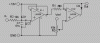
Yes, flip the zener. And change the connection on the input protection diode as shown below.
To protect your engine from excessive boost, just limit the voltage on the end of your boost set pot to the appropriate level. How are you deriving that voltage (+5V?) now? |
|
|
|
|
|
|
(permalink) |
|
oh i forgot, in the simulation i just put a set voltage to pin5 to make it easier to change; i have a trimmer between a +5v and pin5 on my actual board to adjust clamping voltage.
but for the boost protection, this voltage clamp actually makes my motor quite vaulnerable to overboost. the computer gets a voltage from the boost sensor and if it gets to like 4.3v(11 psi) it shuts my engine down, so im putting this clamp in to stop the voltage at 4.25 or so, that way the computer doesnt see past 10.5psi of boost and it wont shut my motor down. so even if im getting 20psi(4.95v) of boost, the computer only sees 10.5psi(4.25v) the problem is that 20psi will destroy my motor so id like to make the clamp have another trimmer to set to a safety point where it will stop clamping and let "input = output" or "input = safety trimmer's voltage" which will let the computer see the real boost and shutdown the motor. |
|
|
|
|
|
|
(permalink) |
|
I think the schematic below will do what you want. The transfer function is posted below the schematic. The LM324 is identical to LM358, except it has 4 amplifiers instead of 2.
|
|
|
|
|
|
|
(permalink) |
|
wow thats awesome, thank you alot. now on to building it lol
ill post back on how things go with it, but it works awesome in my sim thx again, it does exactly what i need it too |
|
|
|
|
|
|
(permalink) | |
|
Quote:
|
||
|
|
|
|
|
(permalink) | |
|
Quote:
As for your circuit, it is designed to be used with a +12V supply. So powering it by 5v (same as the Vref, your input form the sensor) will mean it won't funciton properly. Also, opamps have a 'maximum output voltage' rating. This means that with a 5v supply, the output cannot swing too close to the power voltage. For the LF358, the datasheet, it says with a supply of +/- 15V (thats dual power supply) the output can swing 13v above and below 0v. So, it can't output the same range of voltage as its power supply. Basically, you're powering it by 5v, so, no matter how the circuit is configured, it won't be able to output higher than about 4V, or lower than 1V. When its powered by 12V it is capable of putting out +11v and 1V (with reference the 'GND'/0V) It uses the 5v supply for the sensor as its voltage reference, and the 12V supply as its power. I'm not sure if you know about 'dual rail' supplies (don't want to be patronising here). The link provided in this topic, http://www.teamfc3s.org/info/articles/fcd/diy_fcd.htm, discusses it, but it doesn't actually require it. Its a bit hard to explain :/ Ultimately, if you wish to use that circuit, it must be powered by +12V from your battery. The Vref should be connected to the sensors power supply (+5V) and Gnd, is, well, GND, your chasis (preferably where the sensor connects). 4 connections in total. If you must have it powered by 5V, then things could get tricky, as few opamps can output that close to the power supply (0.3v - 4.7). Although you did mention you wanted it clamped at 4.3, leaving 0.7 between output and power....*might* be possible. I'll wait for your repsonse before I post anything else, sorry I could be of much help this time, Blueteeth.
__________________
Inconsistency is the key to flexibility! |
||
|
|
|