![]() | ![]() | ![]() |
| | |||||||
| Electronic Projects Design/Ideas/Reviews Are you building an electronic project or want to? Maybe you need some assistance? Come and submit your electronic questions here and let our experienced members find a solution. |
| | LinkBack | Thread Tools | Display Modes |
| | (permalink) |
| It's supposed to be simple! big magnets spinning round a fixed coil on one side and on the other a battery and a hole load of bulbs. so i looked on the net to find a circuit to regulate and rectify or rectify and regulate. rectify was easy of cause, ether 1 diode for half wave or a diode bridge for full wave rectification. That just depends whether one side of the coil is hooked up to the mass or not. now we come to the hard part: regulate. there seem to be two schools: clipper circuits or shunter circuits (if there is a difference?). clipper circuits use power transistors. shunt circuits use scr or triacs. both use zener diodes to detect over voltage. now for the details: coil dc resistance 0.247 coil max power output 135w open volts at idle 55Vpeak, 12Vrms open volts at 6000rpm 137Vpeak, 30Vrms idle with 3 wave form is a "sawtooth" now for the circuits: 1st what i call a clipper circuit ![]() when i "spice" this one it works well, but i'm told that it gets very hot because it limits 14A with all the volts the magneto can give (135w for 2 transistors) 2nd what i call a shunt circuit ![]() but the problem is this is a cut down 3 phase circuit and doesn't work well. only one of the scr shorts and the zener diode doesn't change any thing. PLEASE can anybody help me to understand. Neil | |
| |
| | (permalink) |
| Find a schematic for an automotive alternator. They use 6 diodes to rectify 3 phase.
__________________ C:\WHUT ? Beware the asterisk * | |
| |
| | (permalink) |
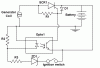
| Car and lorry alternators are very different because they regulate the field winding. Motorbikes have permanent magnet fields. On the shunt circuit, only one SCR is supposed to short at a time. When AC1 is positive, the right hand upper diode will conduct, as will the lower left hand diode. (I can't read the numbers. Sorry). When the voltage is too big, gate current is sent to both SCRs, but only the right hand one is forward biased, so only that one turns on. Then the alternator current flows through it rather than through the right hand upper diode. I did manage to make a motorbike voltage regulator using SCRs instead of the upper diodes. I would short the gate to the cathode when the battery voltage got too big. I had to do that instead of shunting because the small motorbike had a directly lit headlight, which dimmed badly when the alternator was shunted. | |
| |
| | (permalink) |
| i would love to see a diagram of the circuit you made (a diagram is worth a thousand words). I have only modeled the circuits i show in LTspice. I have no idea what they will do in real life. if you have a circuit that really worked ... i have seen on the net some very crude triac stuff and i am trying to model a circuit. i will post a diagram as soon as it models ok or when i get stuck. | |
| |
| | (permalink) |
| Here is the circuit as well as I can remenber it. It is quite a few years since I built it. I found that the funny voltage spikes on automotive stuff is such that I prefer to use discrete components where possible. The same sort of reasons were behind me adding an opto-isolator when there is no isolation needed. The circuit is practically impossible to destroy by simple things like connecting wires wrong, or surges when the ignition is turned on or off. I'm not going to work out values, but here is how it works. The voltage from the generator is rectified by SCR1. Current through R1 will turn on SCR1. D1 will stop the gate voltage going negative on the negative half of the cycle. When the ignition is on, and the battery voltage exceeds the voltage of ZD1, current (limited by R3) turns on the LED in the opto isolator. The transistor of the opto isolator bypasses the R1 current so that SCR1 never turns on. R2 stops ZD1 leakage current turning on the opto-isolator. It is would be perfectly possible to fit several SCRs for 2 or 3 phase generators. I was stuck with a single phase generator because the coil was shared with the headlight bulb, which was directly lit on by AC current. | |
| |
| | (permalink) |
| Diver300, looks really different to all the designs i have seen up till now. i'll try and model it and let you know how it works. Neil | |
| |
| | (permalink) | |
| Quote:
| ||
| |
| | (permalink) |
| "I found that the funny voltage spikes on automotive stuff" well thats normal. when you switch a magneto it gives huge spikes. this circuit is switching on and off each cycle. thats why the regulators are shunt or clipper and not switch. as for three phase regulators i found this on the net: http://www.geocities.com/loudgpz/GPZ...citeField.html i tried to model it in LTspice but it didn't work. the single phase version is above (didn't model ether) but programs are not all and if somebody could tell me if it really works it would be cool. | |
| |
| | (permalink) | |
| Quote:
All the alternators in this thread are permanent magnet ones where the field can be varied. I don't suppose that LTspice can model the generator with a field winding. The induced voltage in the 3-phase windings depends on the value of the current in the field winding, and that is vital to the voltage regulation. | ||
| |
| | (permalink) |
| or this one is another 3 phase circuit. http://www.geocities.com/loudgpz/GPZ...gnetField.html ... but my bike is an old yamaha xt500 and thats single phase :-( | |
| |
| | (permalink) | |
| Quote:
| ||
| |
| | (permalink) |
| hi Nigel, My XT 500 has crappy lights too. The headlight runs strait off the magneto. In fact it has a high power and a low power wires coming from the same coil. all that hooked up to the ground of the bike. the regulator is hooked up to the lights wire (high p) when the lights are on or onto the charge wire (low p) lights off. I want to take the ground off the coil (for full wave rectification) and change from 6v to 12v (thats why i need a good regulator) and last of all replace the battery by a big capacitor. All that said, did you get your dt to shine brightly? Neil PS was it you who already treated a motorbike regulator that blew up a bunch of 2N3055? | |
| |
| | (permalink) | |
| Quote:
IC1 is a TL431 or equivalent. The battery voltage is smoothed by R4 and C1. The voltage is divided by R5 and R6. When the divided voltage is above 1.25, IC1 turns on and turns on the opto isolators. When the opto isolators are on they stop the SCRs from turning on by bypassing the gate current. However, the circuits shown elsewhere in this thread would seem to be more suitable for 3-phase generators. The internal inductance of generators is so large that they can be considered constant-current supplies, so no damage is done by shorting them. The only reason that I built a circuit like this was that shorting the generator effectively shorted the directly lit headlight, run straight from the generator, not from the battery. Any motorbike with a 3-phase alternator won't have a directly lit headlight. If anyone is thinking of increasing the voltage on a small motorbike with a directly lit headlight, it is worth remembering that the current, not voltage is set by the coil design. If you chose a headlight of a higher voltage, but the same current, the generator should light it OK. I had a 1984 Honda CG125, which had a dreadful electrical system. Honda should be ashamed of what they made. It had magneto ignition, a directly lit headlight and no voltage regulator. The battery only powered the brake light, indicators and neutral light, and the battery was in effect used as a shunt regulator. I fitted electronic ignition, and used the magneto coil as an additonal generator coil. That gave me enough power to run the side and tail lights from tha battery. I fitted the regulator that I showed the circuit for. I changed the battery to 12V. On the headlight, it used to be a 25W 6V bulb, with a 5W 6V tail light. The total was 30W at 6V which is 5A. I changed it to a 60W 12V headlight which was also 5A and was lit very well from the existing generator. It was rather dim at tickover, where the low voltage became more important than the constant current at high revs. | ||
| |
| | (permalink) | ||
| Quote:
I gave it a LOT of thought back when I had the bike, as far as I can see the only solution is to rewind the alternator for the higher voltage, and (hopefully) lose the self regulating feature of the coils. The DT400 had a half wave rectifer feeding directly from the low power coil to the battery, no regulator. The headlight bulb connected directly to the high power coil (fed off AC) - at low revs the lights were pathetic, but once you got a few revs on weren't too bad, and didn't increase further with extra revs (self limiting alternator coil). Quote:
| |||
| |
| | (permalink) |
| well i dug out an old post: http://www.electro-tech-online.com/e...ator+motorbike using a single 2n3055? i think the problem with the circuit is that the gain. if nobody can come up with a better circuit i think i will try what i call the clipper circuit. little question: power diodes are expensive(20a) can i use several smaller diodes in parallel? 2nd little question how would it change the circuit to use power pnps? | |
| |
| Bookmarks |
| Thread Tools | |
| Display Modes | |
| |
| | ||||
| Title | Starter | Forum | Replies | Latest |
| Variable capacitor circuits | walters | General Electronics Chat | 83 | 11th March 2008 03:59 PM |
| Three Phase Versus Single Phase For EV | fzn10 | General Electronics Chat | 4 | 31st July 2006 09:39 AM |
| single phase, 3 phase | applman@ixpres.com | General Electronics Chat | 2 | 18th July 2004 11:15 PM |
| 3 phase to single phase | eyeofthefly | Electronic Projects Design/Ideas/Reviews | 34 | 14th November 2003 04:17 PM |
| converting 3 phase motor to single phase | norberto fines | Electronic Projects Design/Ideas/Reviews | 6 | 2nd September 2003 11:21 PM |